
The Generosity (or, why we’re celebrating Luci Shaw’s 97th birthday anyway)
In memoriam: Luci N. Shaw, 1928–2025.

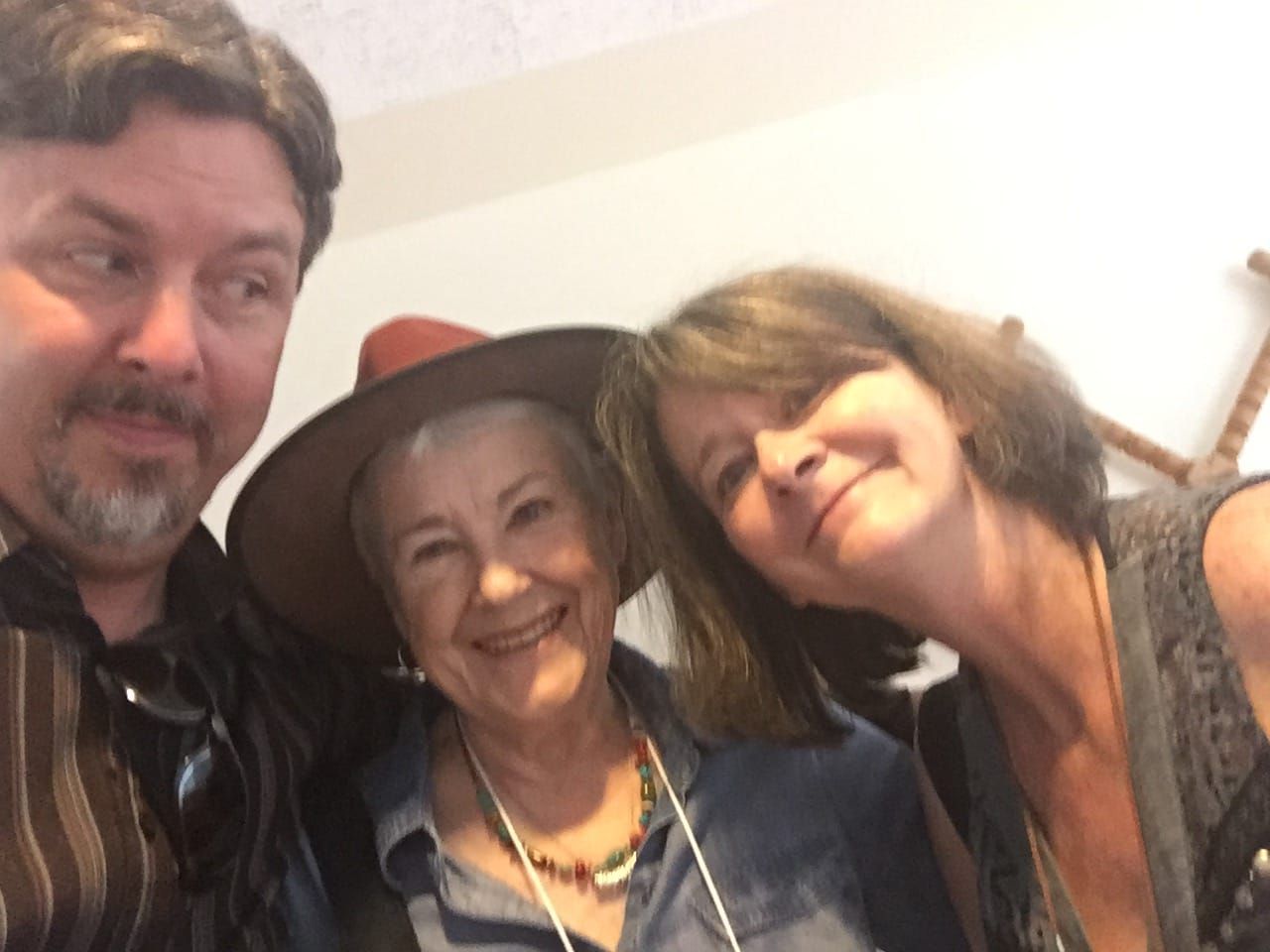
In the first week of December 2025, we said farewell to an exemplary poet and an even greater soul. Communities of art and faith mourned — and will grieve for a long time — the departure of a beloved icon and a devoted supporter. And Anne and I lost one of our closest friends, a woman we have often called our “patron saint” and our “guardian angel.”
After helping her readers glimpse the glory of God through a glass darkly, Luci Shaw has finally passed through that glass into a new relationship with the Divine Mystery that she so joyfully investigated with her journal open, her eyes open, her heart open. This prolific poet and friend of poets spent so much of her life composing and sharing poetry, and she did so in her later years on an almost daily basis — no exaggeration, as those who followed her on Facebook can testify. And we are likely to see even more books of her poetry published, as she was still working with publishers when she passed, and still promoting several recent releases. (Here’s one of Luci’s poems — “December—the 95th Year” — that was published by The Christian Century in 2023.)
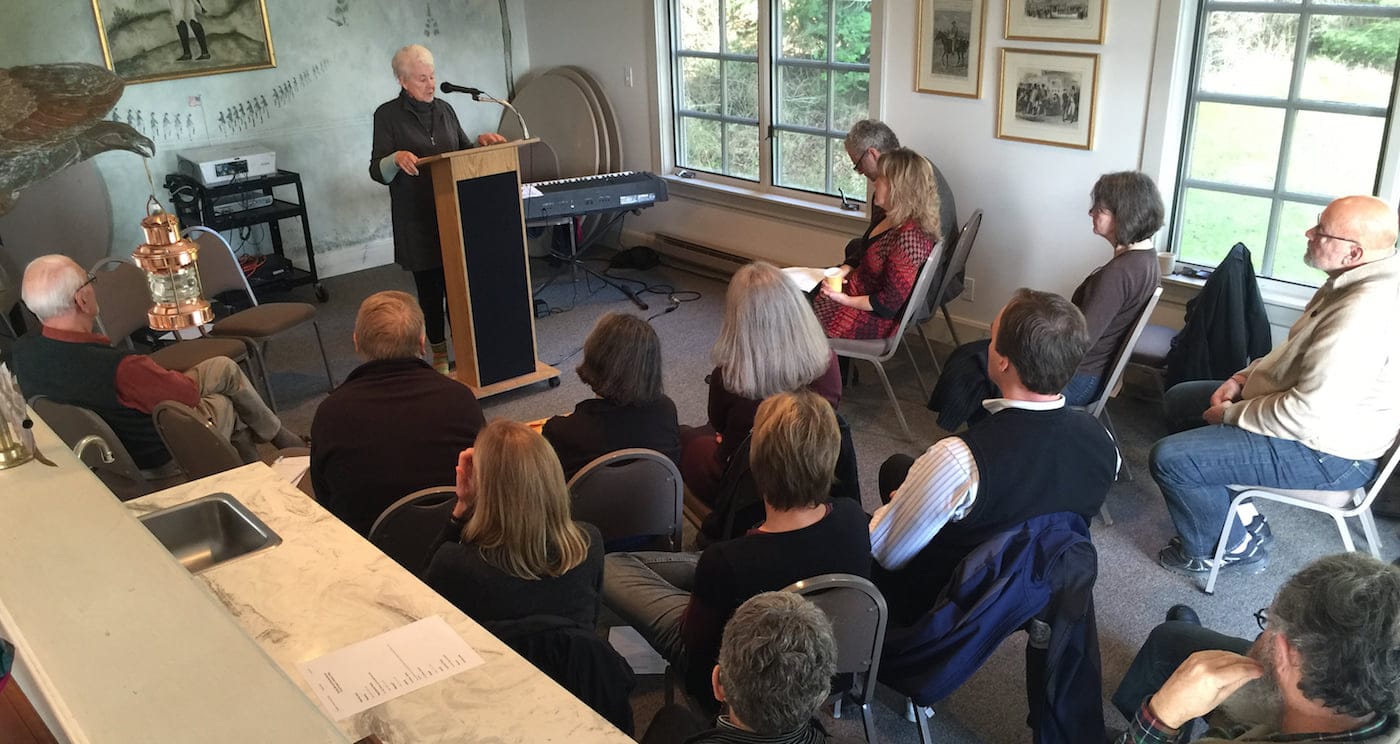
Anne and I weren’t the only ones to describe Luci as a guardian angel. She was revered as royalty by
- almost everyone who has ever been involved in the work of Image, the world-renowned literary arts journal she helped establish and to which she often contributed;
- the devoted community of The Glen Workshop, the annual Image arts retreat, where she was more likely to be found attending workshops to practice new kinds of creativity than she was to actually lead a poetry workshop (although she did that too);
- The Chrysostom Society, a community of Christian writers (of which she was a founding member) that formed in the late ’70s to collaborate and support one another in achieving artistic excellence beyond the boundaries of “Christian publishing”;
- all who love Eugene Peterson’s popular paraphrase of the Bible, The Message, which she worked closely with him to compose;
- church communities across America, especially the Episcopal parishes of St. Paul’s in Bellingham, Washington, and St. Mark’s Episcopal in Geneva, Illinois;
- and arts and education communities from Regent College in Vancouver, B.C., where she served as Writer-in-Residence; to the Festival of Faith and Writing at Calvin University in Michigan; to Wheaton College, her alma mater in Illinois; to Hutchmoot, the Rabbit Room community’s annual arts conference in Tennessee, where she was a keynote speaker in 2014.
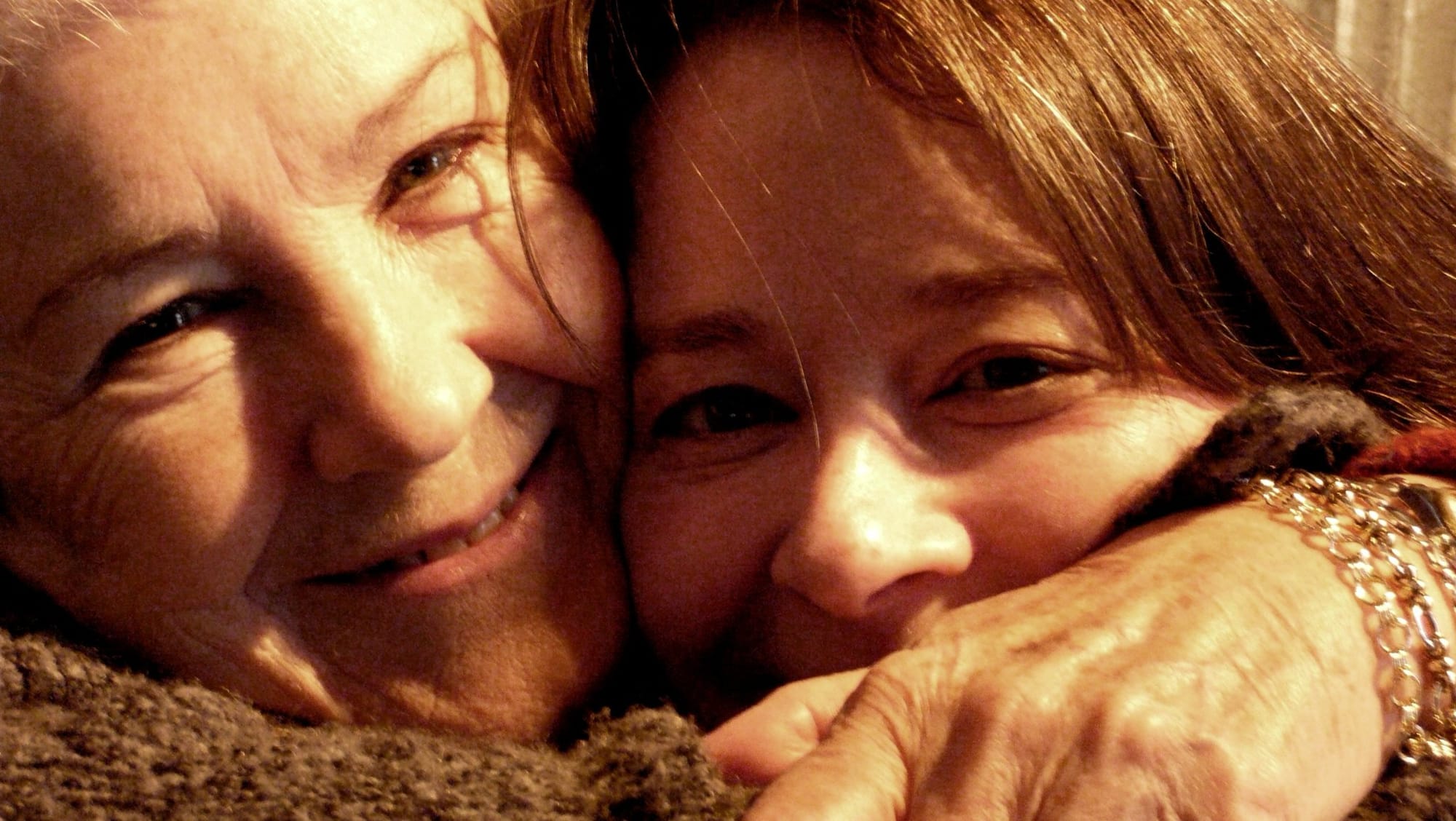
Luci Shaw would have turned 97 on December 29th. She passed away on December 1 in Bellingham, Washington, with her family around her. For much of her last week among us, her husband John Hoyte — a similarly inspiring writer, engineer, painter, adventurer, sketch artist, and sailor — waited and prayed in isolation, struggling with Covid. But he was, thank God, cleared to be with her again, and we were told that their final hours together were intimate and beautiful.
Anne and I visited Luci in her hospital room just a few days before she passed, and we found her lovingly attended to by her three daughters Robin, Marian, and Kristin. She was awake for most of our visit, occasionally drifting off and then startling back awake to ask us questions. She was hospitable, witty, asking us (as always) about what creative writing projects we’re working on these days. She asked (as always) about the state of my work at Seattle Pacific University. She had become, in recent years, increasingly dismayed at an obvious trend: the devaluation of the humanities — especially the arts — in longstanding institutions of Christian education, and my updates from the front lines weighed heavily on her heart. She, like her dear friend and collaborator Eugene Peterson (perhaps SPU’s most famous alumnus), understood that the arts are essential in our apprehension of God, our capacity for faith, and our ability to attend to and love our neighbors.
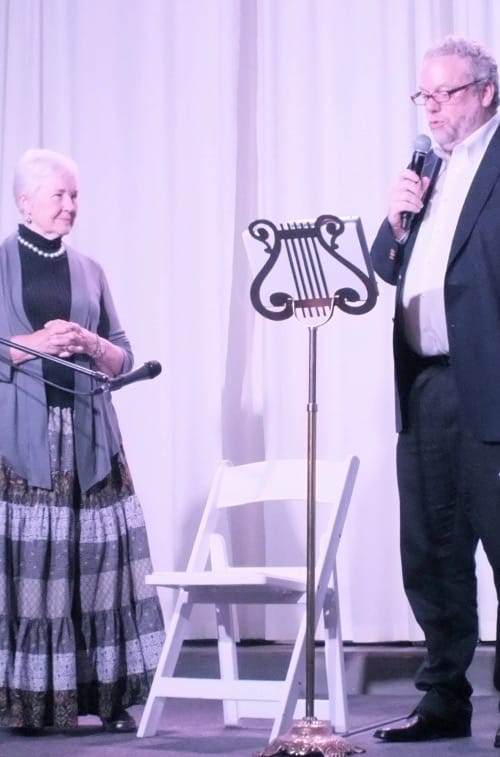
Then, like a talk show host, she enthusiastically described both Anne and me to her daughters, and went on to describe the creative talents of each of them to us. She was still inclined to offer wisdom, and still focused on her lifelong passion: poetry. In fact, at one point she abruptly launched into a recitation of a lengthy children’s poem from a book called Beastly Boys & Ghastly Girls that she remembered from childhood. Line by line, she unfolded its dramatic story with drama and musicality for almost ten minutes.
Over the course of our last conversation with her, Luci’s alertness and coherence varied, but there were moments of remarkable clarity, including when Anne and I rose to bid her our last farewell so that she could rest. She raised her hands and said, “Let me give you a benediction. Garrison Keiller would always say, Do. Good. Work.” We were amazed and blessed. And as we closed the door behind us, we heard her exclaim, “That was fun!” As we walked back through the hospital, we had tears streaming down our faces. But they were, above all, tears of gratitude to have been blessed with so many years of Luci’s generosity.
We will never forget that last visit.
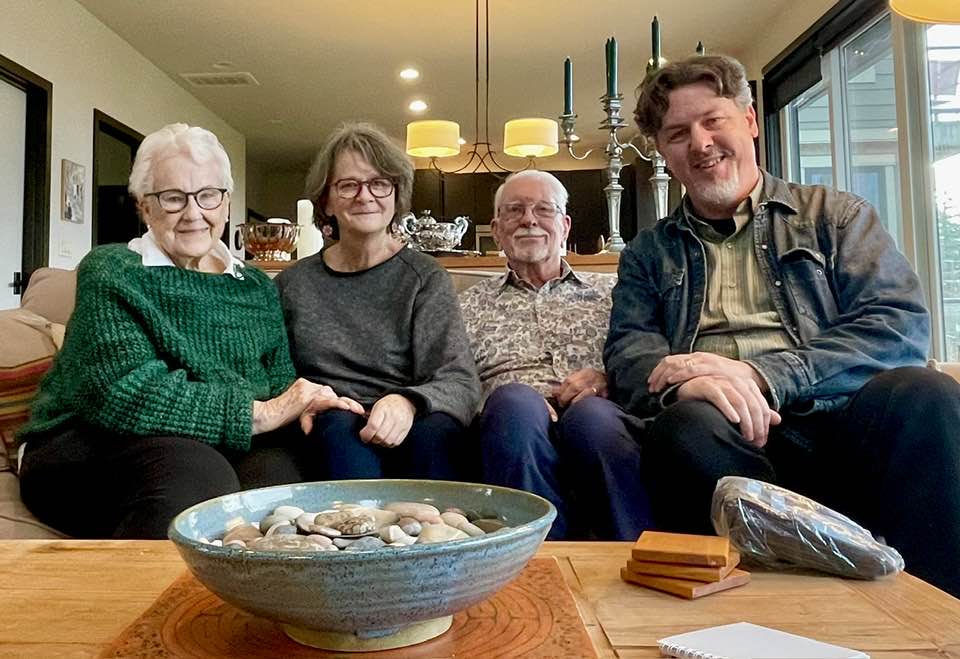
In fact, we still remember the first.
Luci changed my life before I ever read a word that she wrote. When I was in high school in the late ’80s, my English teacher recommended that I read a book by Madeleine L’Engle called Walking on Water: Reflections on Art and Faith, which, we learn, in the opening pages, L’Engle reluctantly wrote at the urging of her closest friend, Luci Shaw, who knew that Christians in the arts needed wisdom and guidance. I certainly needed it, and that book is still a beacon that lights my way. (I own several copies, all of them full of my scribbled comments and exclamation marks.) The name “Luci Shaw” stuck with me. I was curious about her.
When L’Engle spoke at Seattle Pacific University during a writers conference in the late ’90s, I seem to recall that Luci Shaw was there at her side. I probably met her there, as Madeleine was signing my copy of Walking on Water, but I cannot be certain. I did, however, attend a poetry reading at Barnes and Noble a few years later, and Anne and I introduced ourselves there and began a conversation that would never end. Attending the Glen Workshop in Santa Fe in 2004, we asked Luci if she could recommend a Bellingham destination for writers seeking a quiet retreat, and she answered, “Why don’t you and Anne just come to our house beside Whatcom Lake for a weekend every month. We have rooms downstairs where you can stay and work.” We were astonished. We could not manage such regular pilgrimages, but we did accept her generosity, and worked there for two or three weekends every year for many years.
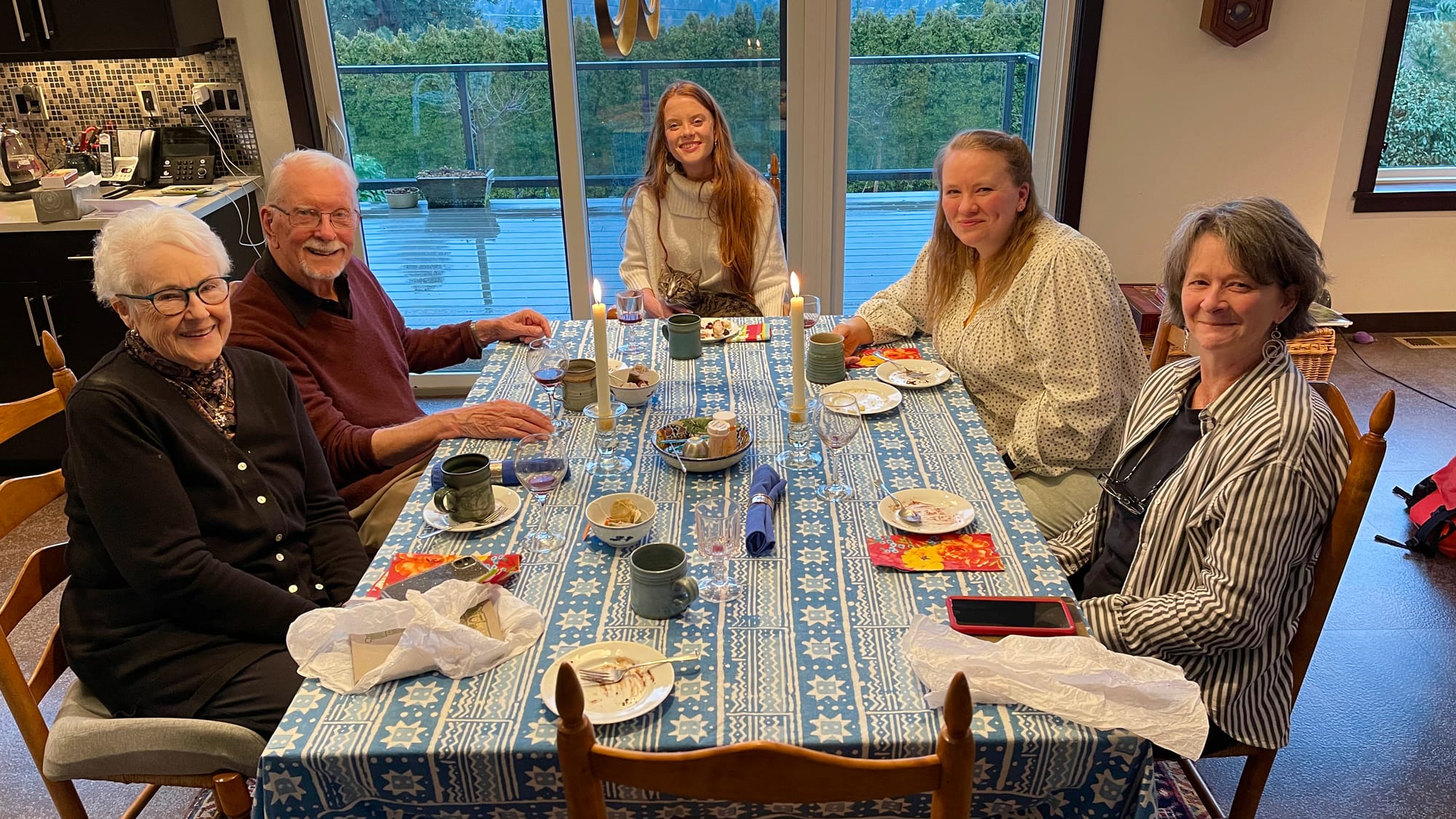
Truth be told, those retreats were not so solitary. We were easily persuaded to join Luci and John for meals, for tea and cookies, for games of Scrabble, for evenings of reading poetry, for movies at the Pickford Film Center in downtown Bellingham. For many years, they hosted an arts gathering in their home called Open Windows. And when my first book about faith and art, Through a Screen Darkly, was published in 2007, she invited me to speak to that group. That was the same year that my first fantasy novel, Auralia’s Colors, was published, a book for which I had drafted full chapters in Luci and John’s lakeside home.
Luci and John were the ones who, in June of 2007, invited Anne and I to be special guests at the Chrysostom Society's next annual gathering at Laity Lodge, in the idyllic Frio River canyon landscape. Anne and I felt like young students of wizardry being invited to address the senior wizards on the faculty of Hogwarts. Anne offered a poetry reading, and I gave a talk about faith and film. As I stood at the podium speaking about Through a Screen Darkly and my debt to Madeleine L’Engle and Luci Shaw, I looked into the attentive gazes of my inspirations: Luci and John, yes, but also Eugene and Jan Peterson, Scott Cairns, Gregory and Suzanne Wolfe, John and Wendy Wilson, Diane Glancy, Stephen R. Lawhead, Harold Fickett, and so many more. Then we were surprised to receive an invitation into membership. Once again, our guardian angel was opening doors for us.
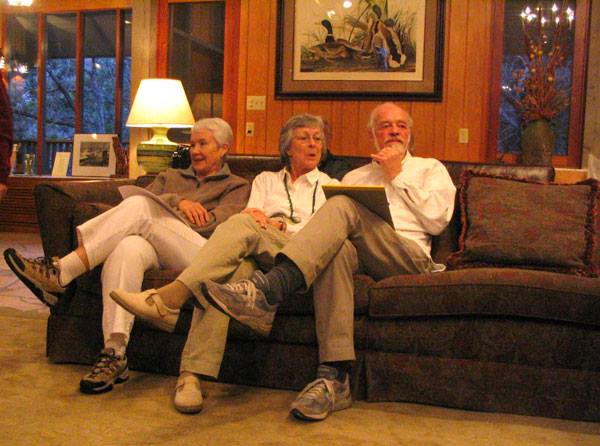
During one of those annual gatherings, the novelist and nature writer Matthew Dickerson challenged Chrysostom members, during a dinner gathering, to compose limericks about Luci by the end of the meal time. I still have several that I submitted:
1.
There once was a poet named Luci
With words she was wonderfully choosy
And as she got older
She fattened a folder
Of poems about John that were juicy.
2.
There was a great poet named Shaw
In whose art there was never a flaw
And yet she felt blue
When among rave reviews
She found one that stuck in her craw.
(I also wrote one for John Hoyte, and another for the group’s namesake, Saint John of Chrysostom. If you’re curious, I’m happy to share them.)
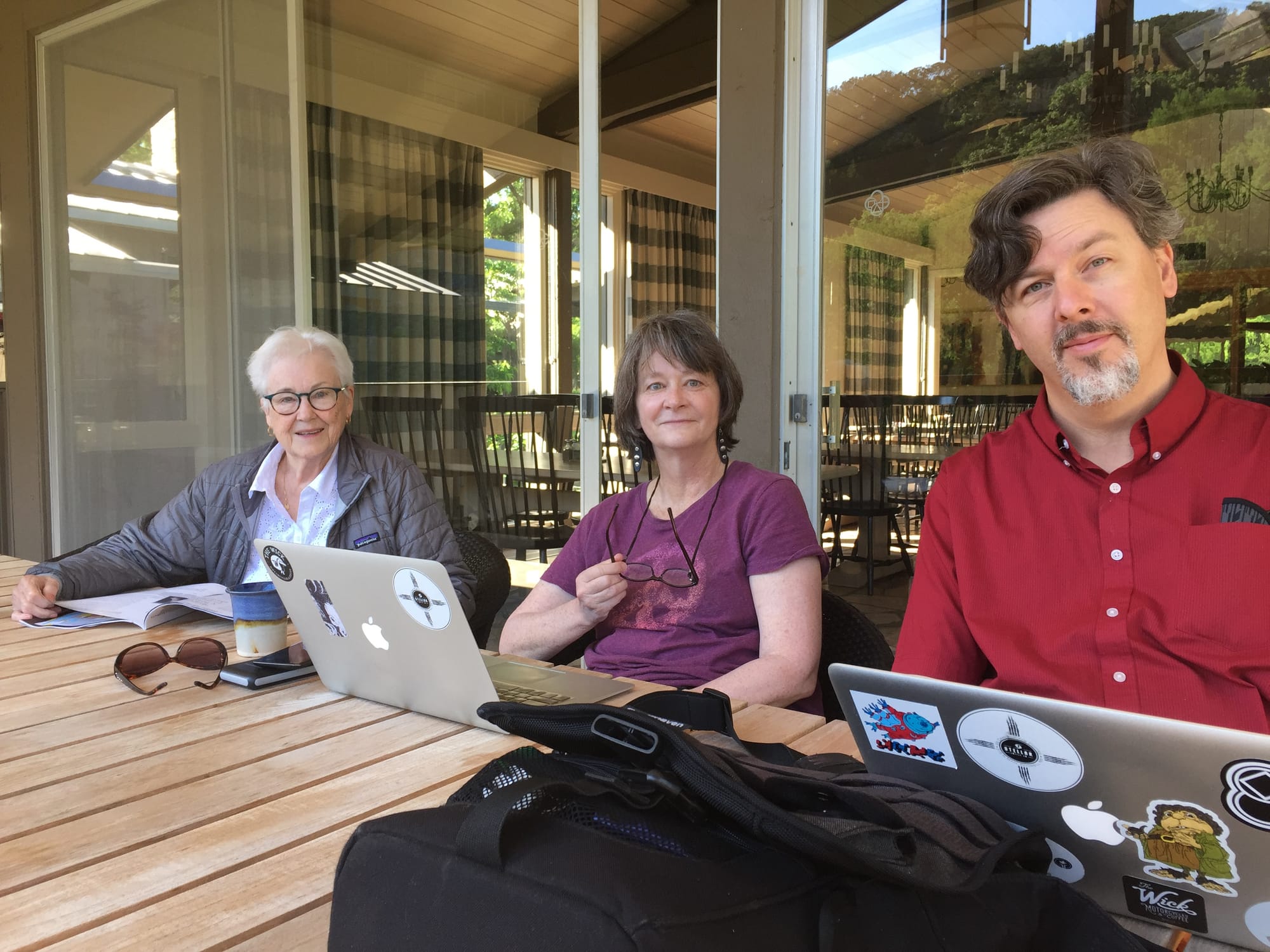
In 2012, Anne was invited to interview Luci for Image journal — a daunting assignment that led to multiple conversations and recordings. Luci spoke to Anne of finding “a parallel between poets and prophets because both speak into a culture that finds it hard to listen. Both bear the burden of calling some aspect of reality to our attention.” At that time, Luci was already writing extensively about aging, and she said to Anne,
As a younger person I wondered what it was like to grow old. No one wanted to talk about it; there seemed to be a conspiracy of silence, as if to discuss mortality were too morbid, and irrelevant to the young. Now that I know more, I want the arriving generations to understand, sympathize with, and support their elders, and allow grace to characterize our interactions. And yes, there’s a certain melancholy that pervades some of these musings. I grieve for the house we just moved out of. I mourn friends who’ve “summited” ahead of me. But mostly I’m grateful for my rich life.
Luci was also influential in Anne’s work as she completed her own collection, Delicate Machinery Suspended. When she recommended the book, Luci wrote, “If you love poetry, you recognize the magic of words that sift the world into its particulates. Anne Overstreet employs the skilled chemistry that swells the words back into realities so startling and new that no object or person remains unchanged.”
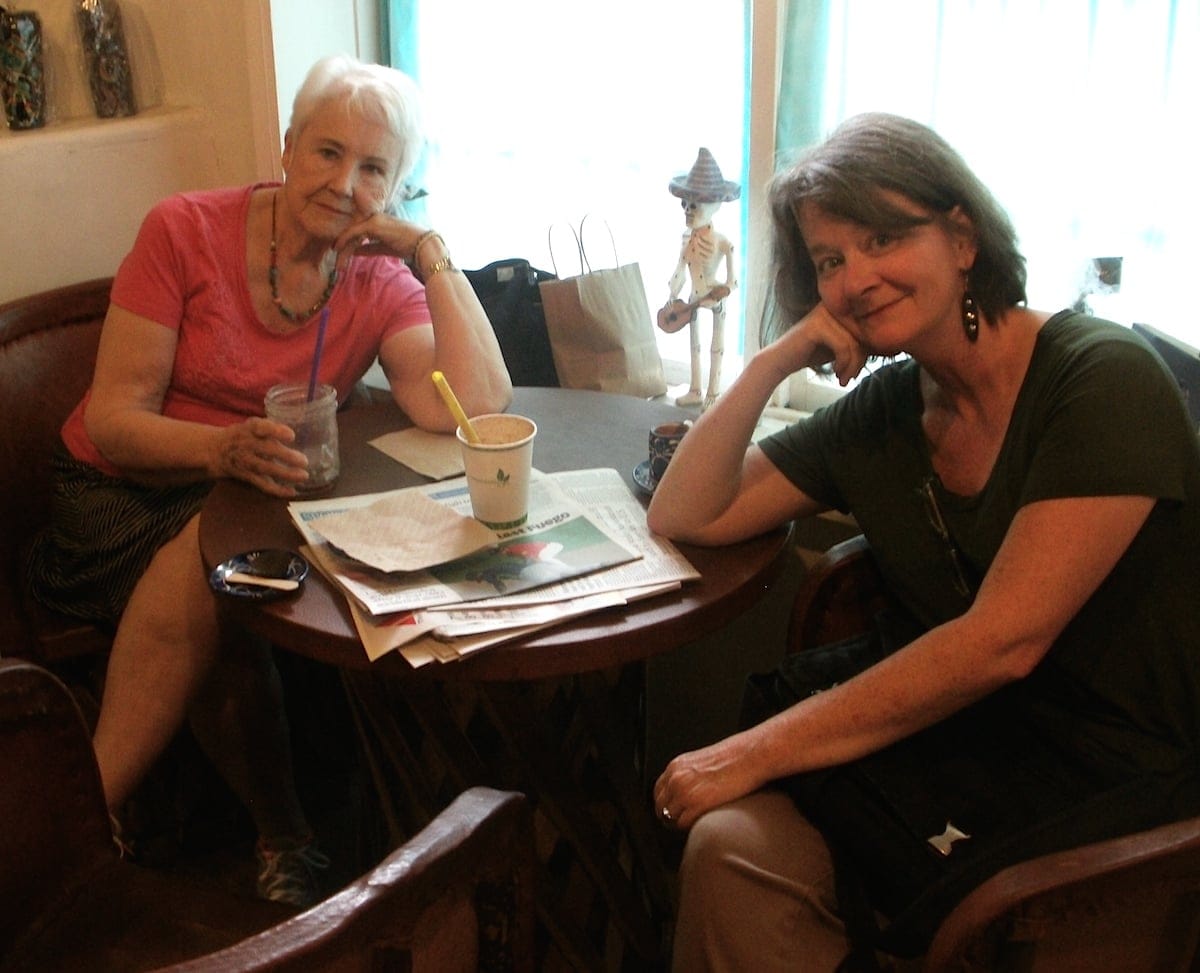
In our visits with John and Luci over the last decade, both of them would frequently ask for our perspectives on what she viewed as an almost incomprehensible decline in America’s leadership, an appalling strain of cruelty, and the seemingly inexplicable support that so many evangelical Christians and Christian institutions were giving to this trend. Their hearts were burdened by the intolerance being shown to LGBTQIA+ communities, as they loved and learned from so many in those communities, and supported them in a welcoming church community in Bellingham. Open to the guidance of the Spirit, and ever so humble, Luci was still learning, still growing, still willing to embrace new apprehensions of God’s truth and love in the world.
In her conversation with Anne, Luci offered these spontaneous insights:
Both good and evil need to be depicted for what they signify, as do violence and healing, perversion and propriety. Poetry is what’s in the trash, under the rug, beyond the line of horizon. It’s the friend whose son has AIDS, whose daughter is marrying a loser, the lake that is stocked with farmed fish. It’s the wind walking on water, the bare prairie in winter, spider silk in sunlight. A poem is so much more than the sum of its words. What makes a work interesting is being able to watch the poet’s line of thought develop imaginatively, noting the contrast between light and shadow; metaphor is often the indirect, yet miraculous way of perceiving that.
The entire universe is waiting to be written about, welcoming, opening its doors to reflection and understanding or attempts to enter mystery, even the disturbances of violence and ugliness and falsehood and broken promises. We live in such a changing, complex, intricately formed universe. Every part of it deserves to be brought to our attention.
In 2023, on the occasion of Luci’s 95th birthday, Paraclete Press produced a video tribute, a remarkable gift, featuring the faces and voices of many who loved her:
On the day after we received her final exhortation and assured her of our love and our gratitude for the last time, I stood before the promising young writers in my Imaginative Writing class at Seattle Pacific. It was our last regular class session of the Autumn 2025 term. I pushed aside my lesson plans, and devoted much of that session to Luci, introducing my students to her legacy. I recommended that they learn life lessons from her inspirational book The Crime of Living Cautiously (InterVarsity Press, 2005), and shared anecdotes of her adventurousness (like the time she used her senior-citizen discount for her first experience of bungee-jumping). I also shared some videos of her talking about the value of poetry . . .
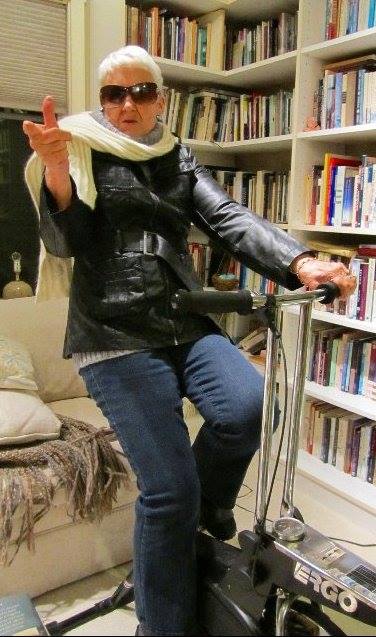
. . . and photographs that demonstrated her playfulness. I told them about how she once, welcoming us for another stay at her home, announced her excitement about her latest purchase: a black-leather motorcycle jacket. She put it on to model it for us, and we were mightily impressed. “It’s too bad you don’t have a motorcycle,” I said. “We would have set up a photo session for you.” She smiled mischievously and replied, “Well, I do have an exercise bike!” We went to work.
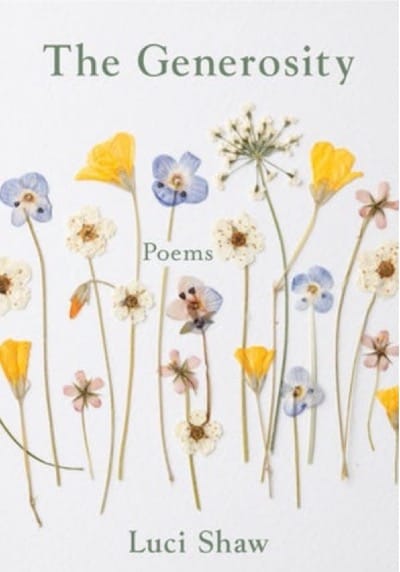
And then, before my students turned their attention to the day’s assignments, I picked up one of Luci’s most recent collections — The Generosity, published by Paraclete Press in 2020 (and celebrated with this book-lanch event preserved on YouTube). And I promised them that any poem I randomly opened would be worth their attention. When I looked down at page 42, I saw I’d turned to a poem called “Presence.”
And as I read it to them, I marveled at how perfectly it introduced her voice and her style to them, and for how it captures her spirit so fully. It also moved me to tears as I read, for it sounded like just the kind of poem that one might compose and then find oneself caught up into the arms of her Creator.
Grateful for permission from Paraclete Press, I offer this to you in memory of our inspiration and our friend:
Presence
I long to write a poem
spare as a small, open window,
allowing in only enough air
to move the curtains briefly
(a hint speaks truer than a gust).
Maybe there’ll be enough
salt in it to alert you to the ocean,
somewhere out there, beyond
the red cliffs, you may even hear
waves breaking on gravel—
that coarse sound. Or you may
sense it only by intuition, the way
you know, without seeing, that
someone you love is nearby.
[“Presence,” from The Generosity, p. 42, by Luci Shaw. Paraclete Press, 2020.]
- For a more detailed, formal obituary and remembrance, read “Remembering Luci Shaw,” published by Regent College.
- For a reflection composed by the essayist and poet Hannah Hinsch, visit A Window Mood.
- I highly recommend that you read John Hoyte’s extraordinary memoir, The Persistence of Light (Terra Nova Books, 2018), at some point, even as you make your way through Luci’s incredible collection of memoirs, poetry collections, and spiritual reflections. Of those, I most recommend The Crime of Living Cautiously, What the Light was Like; Polishing the Pestoskey Stone; Harvesting Fog; Breath for the Bones: Art, Imagination, and the Spirit; The Generosity; Scape; Reversing Entropy; and the latest: An Incremental Life.