
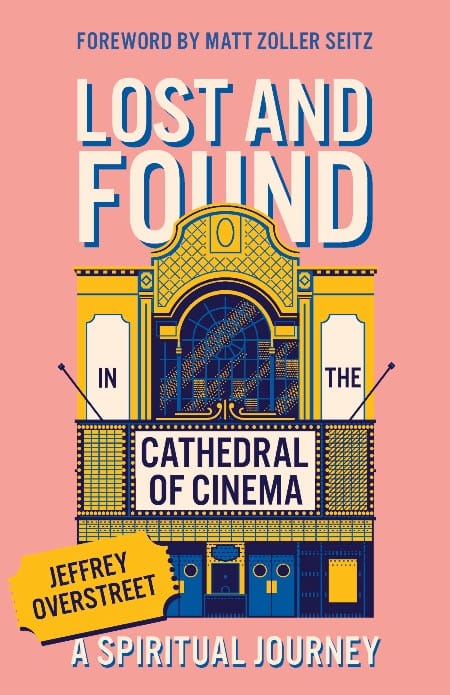
Lost and Found in the Cathedral of Cinema
Recent Readings and Book-signings
- Tuesday, May 12: Seattle Pacific University, Ames Library, Seattle, 3:30 PM
- Thursday, May 28: Third Place Books — Lake Forest Park, 7 PM
- Tuesday, June 9: Hugo House, Seattle,
- Thursday, June 11: Village Books, Bellingham, WA,
- June 17–21: Film seminar at Laity Lodge Creativity Week, Leakey, TX
- July 14: Hugo House, “Industry Talks: A Writing Life as a Practice of Play”
Upcoming Readings and Book-signings
- Tuesday, July 28: Drumlin (in partnership with Ridgecrest Books), Shoreline, WA, 6–8 PM.
Reviews
- Victoria Emily Jones, Art and Theology, May 26, 2026
- Sarah Welch-Larson, Seeing & Believing, May 12, 2026
Text Interviews
- Cinema Sugar: transcript of a conversation with Chad Comello, May 8, 2026
- Fellowship & Fairydust: interview by G. Connor Salter, May 7, 2026
Podcast Interviews/Conversations
- Chrisicisms: a conversation with Chris Williams, May 18, 2026
- Shifting Culture: a conversation with Joshua Johnson, May 15, 2026
- The Collision – Faith & Pop Culture: podcast, YouTube, a conversation with Daniel Blackaby and Nyah Carlson, May 14, 2026
- A Matter of Faith: a conversation with Simon Doong and Lee Catoe, May 14, 2026
- In & Out of Weeks: a conversation with Ken Priebe, May 7, 2026
- The Overthinkers: Apple | Spotify, a conversation with Joseph Holmes and Nathan Clarkson, April 27, 2026
Order a copy for yourself and another for a friend, and you’re all set for several months of reading, watching films, and rich, rewarding discussions.
 Jeffrey Overstreet
Want to interview Jeffrey about this book? Host a reading and book-signing? Invite him to lead a film seminar or a movie discussion event? Email overstreetreviews@gmail.com.
What if watching movies could be a spiritual discipline?
For one film critic, great films became guiding lights – an escape from fear-based religion into richer experiences of imagination, beauty, community, and faith.
Growing up in a bubble of churches and Christian schools, Jeffrey Overstreet was taught by example to be fearful — and even condemn — “worldly” art and culture as predatory and poisonous. Movies and popular movies were made to seem as dangerous as hard drugs.
Yet, the flicker of light from cinema screens proved a temptation too powerful to resist. And what he found there was quite the opposite of what he’d been told:
He found God at play in ten thousand theaters.
Now, through deeply personal and eye-opening stories, Overstreet invites you to retrace a revelatory journey:
- from Pinocchio to My Neighbor Totoro,
- from Disney's Hundred-Acre Wood (The Many Adventures of Winnie the Pooh) to The Tree of Life,
- from The Black Stallion to Blade Runner, and
- from Dead Poets Society and Do the Right Thing to Moonrise Kingdom and Marcel the Shell with Shoes On.
Spoiler! Movies do not burn down Overstreet's faith. Rather, they free him to answer the Scriptures’ instruction — not only to love the world, but to learn from it. Great cinema invites us to hear a holy voice in the beauty of the natural world, and to break away from destructive distortions of Jesus’s teaching.
Guided by the light shining through screens and Scripture — which, he argues, is the same light — the author of Through a Screen Darkly and the fantasy novel Auralia’s Colors testifies of a God who moves in mysterious ways, calling us into a life of courageous creativity.

Praise for Lost and Found in the Cathedral of Cinema:
“I truly believe there is a ‘golden ratio’ hidden within storytelling. When revealed to an audience, is that man touching the divine? Jeffrey Overstreet’s personal journey through film makes a darn good case for it.”
— Andrew Stanton, writer and director, Finding Nemo and WALL-E
“There are writers who astound me with the depth of their love and knowledge of cinema. And there are writers who pursue the truth and beauty of the divine, and reject the ignorance of the doctrinaire, with a rigor that inspires me beyond words. Jeffrey Overstreet is the very rare writer who does both. The gorgeous, jewel-like essays in Lost and Found in the Cathedral of Cinema add up to a singular confession of faith, a revelatory memoir of artistic discovery, and a much-needed reminder of God’s presence in all spaces where light and darkness converge, movie theatres very much included.”
— Justin Chang, Pulitzer Prize-winning film critic, The New Yorker
“Jeffrey Overstreet writes about movies in an engaging and inspiring way — full of enthusiasm, curiosity, and heart. He finds surprising and beautiful connections between his own faith and the stories we experience on screen, whether it’s the playful joy of The Muppets, the quiet grace of The Black Stallion, or the magic and mystery of The Secret of Kells. His reflections are easy to read yet deeply moving, making you want to revisit old favorites with fresh eyes. I’m truly honored that my own work is part of this thoughtful celebration of cinema.”
— Tomm Moore, writer and director, The Secret of Kells, Song of the Sea, and Wolfwalkers
“Jeffrey Overstreet’s love of movies shines through every page of this engaging and thoughtful book. I suspect that I’m one of many readers who will be inspired by Overstreet’s reflections to consider how movies have been formative in our own lives.”
— Kathleen Norris, author of Dakota: A Spiritual Geography and co-author of A Whole Life in Twelve Movies
“Great writing about film is as rare and beautiful as a great film itself. No surprise, because it requires many of the same attributes. Chiefly, a consideration for the time invested by its audience and a strong, unique point of view. Overstreet’s writing is rich with both. Entertaining, personal, stirring and extremely well-thought-out, you may just emerge a more perceptive, emotionally engaged moviegoer (and person) by the end.”
— Chad Hartigan, writer and director, This Is Martin Bonner, Morris From America, and The Threesome
“Jeffrey Overstreet is a bridge builder, a writer who desires to connect what some perceive as disparate worlds — the world of faith and the world of cinema. In increasingly divisive times, where faith is weaponized and art is minimized, Overstreet invites us into a deeper relationship with both, to discover how the study of one can inform our understanding of the other, and how faith and art in concert help keep us open to the staggering and beautiful mysteries that surround us. This is devotional reading.”
— Scott Teems, writer and director, The Lowdown, Rectify, Narcos: Mexico
“Jeffrey Overstreet gets it. He knows the faith-fueling power the cinema can hold. In Lost and Found in the Cathedral of Cinema, he writes about the movies with a novelist’s passionate flair and a memoirist’s confessional vulnerability. This is the rare book that is criticism, drama, and memoir all at once.”
— Josh Larsen, Filmspotting podcast, author of Movies Are Prayers and Fear Not! A Christian Appreciation of Horror Movies
“Some of us, fleeing religion, found refuge in cinema. Some of us feel closer to transcendence, or mystery, or our true selves inside a movie theater than we ever did in a church building. But Jeffrey Overstreet doesn’t see a tension between his abiding faith and his love of film — they clearly nurture and inform each other, and cinema helped save him from the literalism and dogmatism and all the worst tendencies of organized religion without destroying his faith in its brightest mysteries. This book, like all of his best writing, is an open vein — a torrent of beautiful poetry and raw vulnerability and illumination, bringing us deep inside the cathedral of his life experience and letting us see movies (both familiar and foreign) through his astonishingly perceptive eyes. Has there ever been a more persuasive, more faith-kindling pastor of film than Jeffrey Overstreet? I think not.”
— Tim Greiving, author of John Williams: A Composer’s Life
“The mysteries of childhood awe can feel so far away from the pain of adult loss, but in this carefully-wrought memoir of a life steeped in cinematic imagination, Jeffrey Overstreet reveals the path that connects them. This is a deep and devotional read as only he could have written.”
— Sara Zarr, author of A Song Called Home, host of This Creative Life
“Jeffrey Overstreet is an eloquent lover of art and people and Jiminy Cricket. As a child he took to heart Mr. Cricket’s counsel to Pinocchio (‘Let your conscience be your guide’) and has yet to stop showing us what having an incarnate conscience looks like. With Lost and Found in the Cathedral of Cinema, he invites us to enter into the infinite play (‘Play without ceasing’) that sustains him. It’s memoir and analysis and a call to see and feel and give form to our feelings as if our souls depend on it. Turns out they do.”
— David Dark, author of We Become What We Normalize and Everyday Apocalypse
“I’ve often thought that to be a good film critic you need three things: a curiosity-leading-to-experience-leading-to-knowledge about cinema, a facility with language, and a hunger to reflect on, if not to fully understand, the world. Much writing about movies lacks at least one of those — and too often folks think being a ‘film critic’ means nothing more than to criticize, rather than to hold cinema with care, ready to offer tenderness as well as provocation in response to its light. All art is an expression moving closer to or further from truth and beauty, and the best responses to the art of movies are works of art themselves. Lost and Found in the Cathedral of Cinema is definitely among them.
“Reading it I kept thinking that I was being granted a glimpse not only into the life of its author, but into the world he grew up in and inhabits, and the kaleidoscopic history and magnificent complexity of our shared favorite artform. You will certainly learn a lot about the wonder of movies here — offered with rare depth, humility, and full embrace of those three things most necessary for good writing about film.
“More than that, this unquestionably lovely, loving book is a generous, spacious invitation: look closer, and you may just see yourself, en-light-ened.”
— Gareth Higgins, author of How Not to Be Afraid, Cinematic States, and co-writer of A Whole Life in Twelve Movies; co-founder of www.theporchcommunity.net
“More than a longtime lover and sometime reviewer of films, Jeffrey Overstreet is clearly an auteur, whose eye assists our less observant eyes in attending to the miracle of film — that is, to the miracle of light troubling the surfaces of all we see. His careful and profoundly canny articulations are keen to share what his generous eye has observed. He has made me gratefully more attentive as I behold the lay of the cinematic land, and the lay of the light that illumines both that land and my own heart.”
— Scott Cairns, author of The End of Suffering and Correspondence with My Greeks
“This is not just a book for movie lovers, although it is that, too. In Lost and Found in the Cathedral of Cinema, Jeffrey Overstreet seamlessly and expertly blends pieces of his life with his knowledge of and love for film into a compelling story of its own. In so doing, he offers a testament to the power stories of all kinds have not only to shape our lives but to help us to better understand them, too.”
— Karen Swallow Prior, author of The Evangelical Imagination: How Stories, Images, and Metaphors Created a Culture in Crisis
“No one has ever written about the Muppets and Jim Henson more profoundly or authentically than Jeffrey Overstreet. I love the Muppets, but, reading Overstreet, I love them even more. His gratitude to Henson spills over into my gratitude to Overstreet. Essays on Disney’s Pinocchio could fill an encyclopedia, but few if any so insightfully put that film in dialogue with del Toro and Benigni — and Collodi as well. And that’s apart from Overstreet’s exploration of the film’s effect on his students today and its ambivalent significance for the religious world of his upbringing. And I may never again watch Paterson (one of my favorite films!) without thinking of the magic trick by which the author connects it, via femininity in various 1980s movies and in scripture, to the documentary Man on Wire. Great film writing is not just about film, it’s about everything. Read this book and you’ll see what I mean.”
— Steven D. Greydanus, creator of Decent Films and Dailies & Sundays
“Lost and Found in the Cathedral of Cinema is easily one of the best film books you’ll read this or any year, not only because of Jeffrey Overstreet’s gifts as a writer — which are many — but also because of the underlying vulnerability, generosity, and spirit that flow throughout its pages. Overstreet is a seeker, a student, and a teacher, and as he weaves his life’s narrative through reflections on the films that helped shape his journey — from The Muppet Movie to The Tree of Lifeand everywhere in between — he also provides a road map for how curiosity, creativity, faith, movies, and community can help us stay open to wonder, steady our hearts in difficult or uncertain times, and keep us reaching for the light.”
— Chad Perman, founder and editor-in-chief of Bright Wall/Dark Room
“Cathedrals, more than any other kind of church, invite awe and prayerfulness, a space dedicated to contemplating the divine. In Lost and Found in the Cathedral of Cinema, we find Overstreet examining his own spiritual development through the lens of movies that have sung to his soul throughout his life. His writing brings together both the form and the function of cinema gracefully — I’ll be thinking of the way he describes a lovely moment in Kogonada’s Columbus, and the ways that scene reach toward a higher reality, for a long time. Overstreet is a seeker of beauty, a kindred spirit for readers and cinephiles who are interested in sifting through art to find what is good and true.”
— Sarah Welch-Larson, author of Becoming Alien: The Beginning and End of Evil in Science Fiction’s Most Idiosyncratic Film Franchise
“This is the spiritual sequel to Overstreet’s first book on faith and film, Through a Screen Darkly. That book changed my life. Like the best movie sequels, Lost and Found is somehow familiar and surprising — this is a necessary and compelling meditation/memoir that builds upon what came before even as it explores new cinematic cathedrals and attends to the spiritual treasures therein. Whether celebrating the wonders of My Neighbor Totoro, teaching his students about the whimsy within Moonrise Kingdom, or drawing unforeseen connections between Terrence Malick and Marcel the Shell with Shoes On, Overstreet is an impassioned evangelist for cinema.”
— Joel Mayward (PhD, University of St Andrews), author of six books including Theology and the Films of Christopher Nolan: Cinematic Transcendence
“Not since Sofia Cavalletti’s classic The Religious Potential of the Child have I read a book that so beautifully conveys the spiritual imagination of children. Jeffrey Overstreet’s new memoir is the story of one astonished discovery after another, all thanks to great movies watched at exactly the right moment. Lost and Found in the Cathedral of Cinema delights as much as it informs.”
— Paula Huston, author of The Hermits of Big Sur and One Ordinary Sunday
“As a boy, I feared film as the devil’s domain. Later, I learned to be entertained by movies and cull them for (often bad) sermon illustrations. But it took much longer to receive the grace film offers, to encounter the shimmering wonder, the unsettling disruption, the mercy. I wish I’d known Jeffrey Overstreet earlier because he would have helped me encounter a whole other world of joy and illumination. But now, here he is, helping us all.”
— Winn Collier, director of the Eugene Peterson Center for Christian Imagination and author of Love Big, Be Welland A Burning in My Bones
“The key thing missing from much of contemporary American Christianity happens to be the thing Roger Ebert famously said movies were built to generate: empathy. In this wonderful book, Jeffrey shares how a Christian with a lifelong love of movies managed to cultivate a deeply empathetic faith in spite of an American Christian culture that encourages fear and isolation.”
— Zach Malm, Veterans of Culture Wars podcast
“No living soul today has shaped and influenced my outlook on art, storytelling, and spiritual mystery more than Jeffrey Overstreet. His new book is a thoughtful well of deep and profound wisdom, which literally sheds light on many films we both love dearly. I’ve learned so much from him already, but I still wish I could enroll in one of his classes!”
— Ken Priebe, author of The Art of Stop-Motion Animation and Goblabet: An Alphabetical Murder Mystery (With Goblins!)
“Reading Lost and Found in the Cathedral of Cinema is like getting to sit across the table from Jeffrey Overstreet while he describes a movie you’ve just seen in ways that make you see it all over again. In this memoir, he weaves conversations about film, music, literature, pop culture, faith, and beauty together so effortlessly you almost don’t notice that it’s all hanging on thoughtful, complex analysis. What we learn through film so deeply influences the way we understand the world and our place in it, and it is a powerful element in how we imagine our shared past. We don’t often reflect on how formative it is in shaping the way we choose to move through the world. I’m so thankful that with this book Overstreet has given us such a beautiful example to follow.”
— Lindsay Stallones Marshall, assistant professor of history at Illinois State University