Man With a Movie Camera (1929): a Filmwell dialogue
[This dialogue was originally published at Filmwell by the site's founders — myself and Michael Leary. We were working our way through discussing the Top Ten films from the recent Sight & Sound Greatest Films poll.]
•
Leary:
Man With A Movie Camera
Man With A Movie Camera
Overstreet:
Perhaps that’s for the best. It’s only been in the last decade that I’ve really learned to see cinema as something more than a way to illustrate a narrative. Man With a Movie Camera is the work of someone who saw — far ahead of his time — that cinema was an art form unto itself, a way to express ideas not only through images but through editing and juxtaposition, through alternating light and dark, fast and slow, rhythm and arrhythmia.
Vertov was a new kind of poet,and watching him work I now understand better some of my favorite films — Wings of Desire (with its God’s-eye view of a city by day and night), The New World (with its poetic associations of human beings and objects), even the Twin Peaks series (which is obsessed with electricity, motors, and machines). I see ideas masterfully conveyed here that I thought were quite innovative in those much, much younger films.
Living Russia Wings of Desire
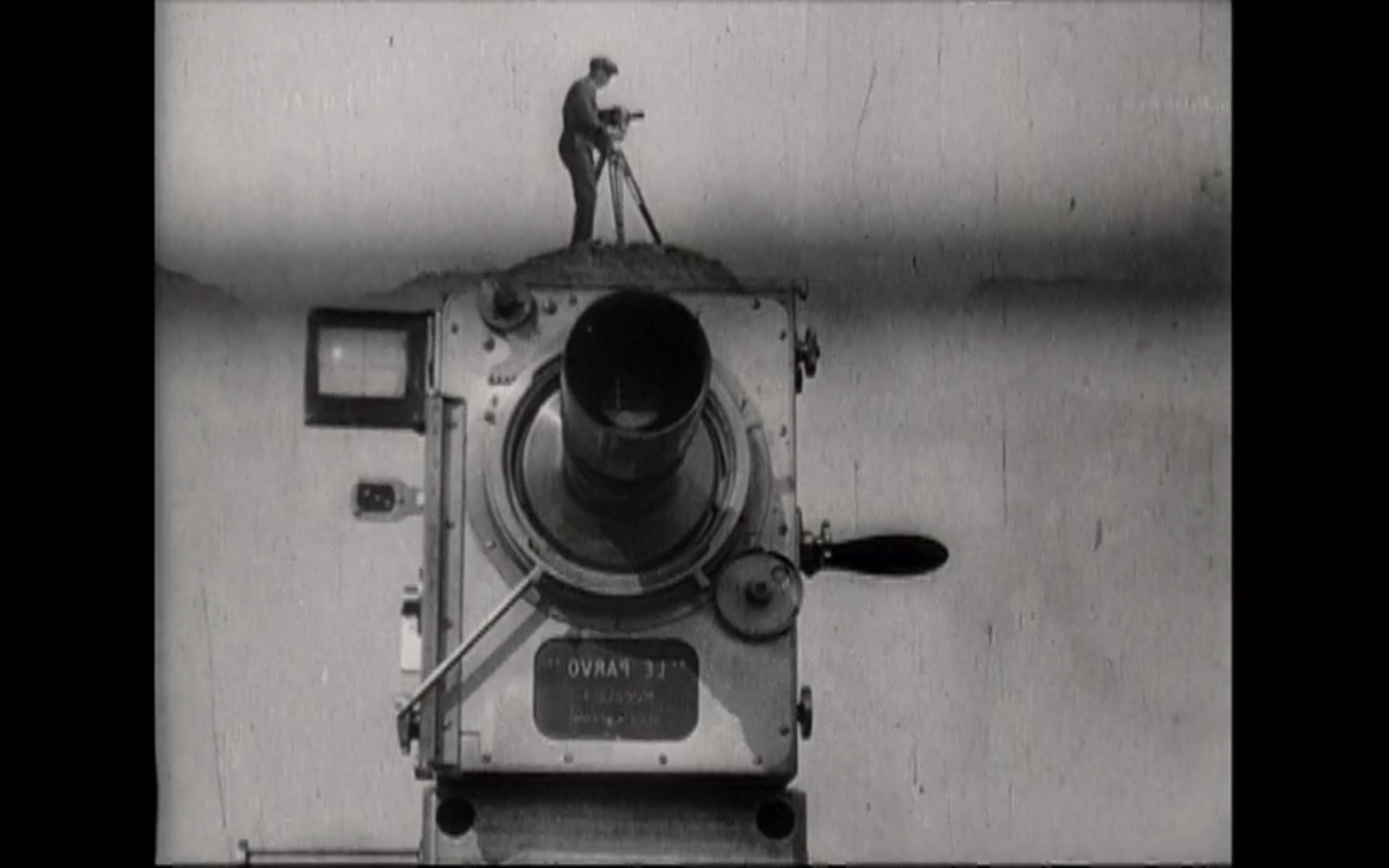
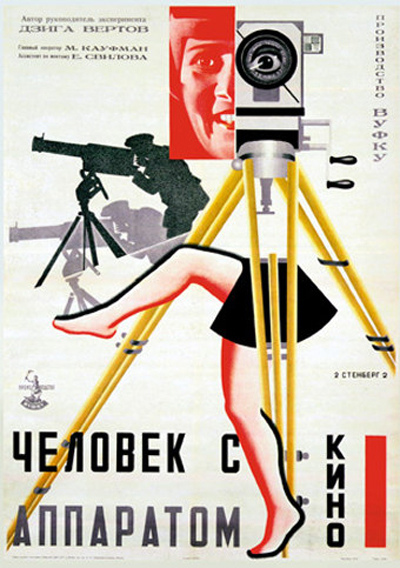
And this is set up from the opening shot, which literally declares “This is a film on film.” But even this is conveyed visually, with a cameraman climbing out of a camera and setting up a camera on top of it.
•
Leary:
about
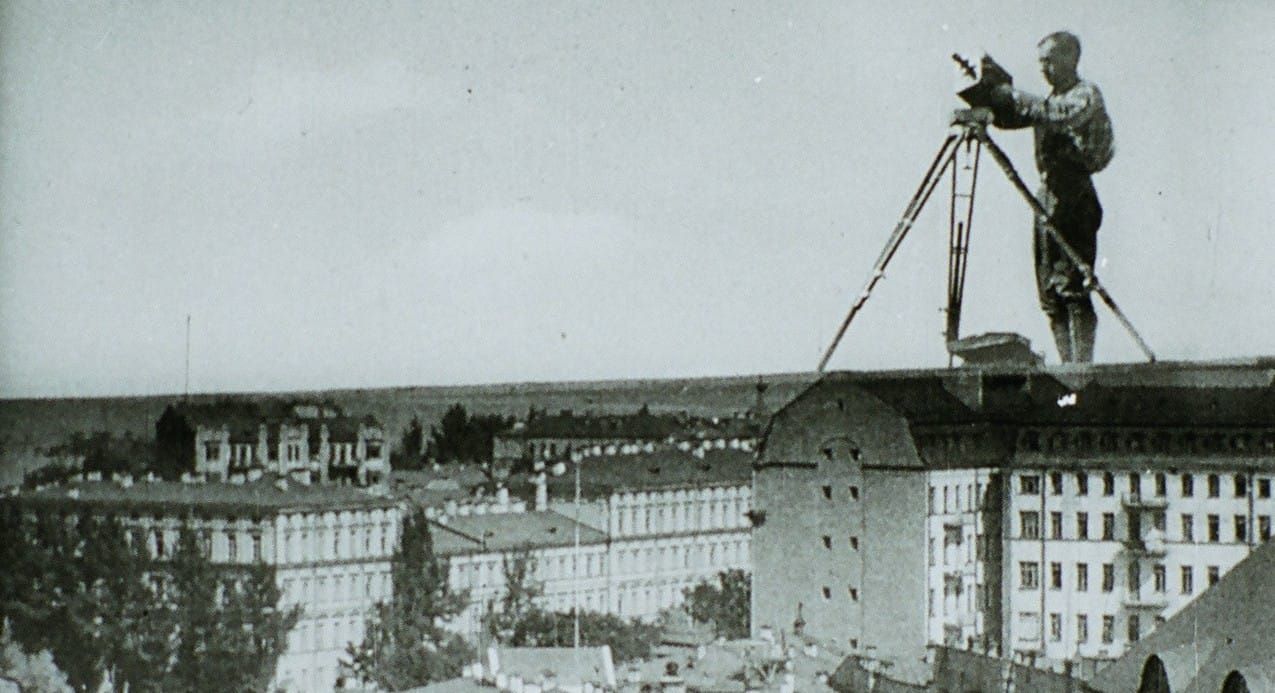
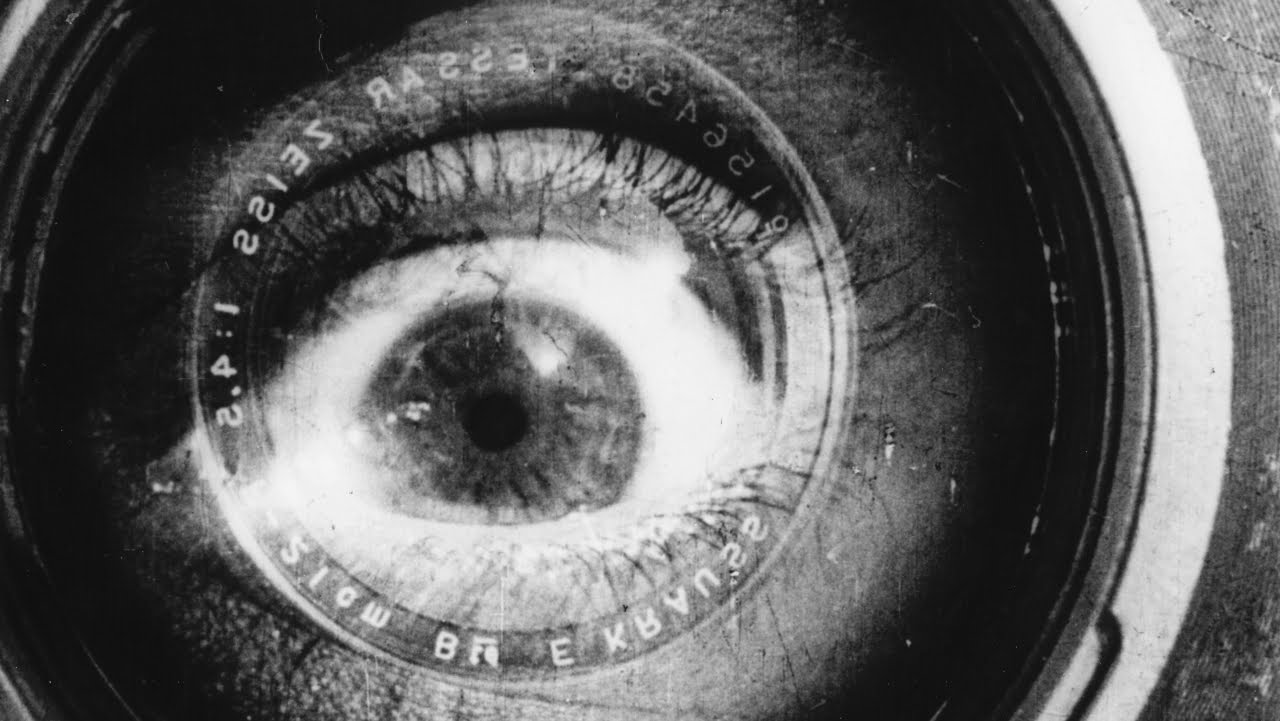
One of the most joyful filmed sequences I can think of is the extended scene in which Vertov is in one car filming a cameraman filming a third car. These three vehicles weave back and forth across the lanes, Vertov's camera swinging around to catch another angle as his cameraman in the frame is doing the same thing. Along with all the other shots of camera lenses unfolding like a flower, a tripod scooting around on its own, and similar frequent references to the act of filming something, I think the best way to describe what is happening here is Vertov telling a story about the camera coming to life in history as a powerful way of seeing and communicating.
Overstreet:
I suspect we can find a variety of opinions about what the film’s “narrative” might be. For me, it looked like the narrative of a city over the course of a day. Juxtaposing shots of individuals waking up with shots of the city itself coming to life, he is making a character of the city, and this film is a story of the city’s wild, complex, sometimes glorious and sometimes troubled life. It becomes both particular in its details and “everycity” in its documentation of common human experience.
It’s also a narrative about the wonder of being an embodied human being, taking us on a tour of human experience. It chronicles so many basic functions — even some downright clinical footage of childbirth that is still shocking today. We explore emotions like exhilaration (manifested with the recurring sight of engines and motors and locomotives) and curiosity (by documenting endeavors to place the camera in unlikely places). Whatever the camera frames, that subject ends up telling us something about ourselves.
So it’s kind of ironic that, for all of the wonders that Vertov’s camera capture, he constantly exposes the camera’s limitations as well. One of my favorite shots is just a close-up on a sleeping woman’s arm bent back over her head, like a square cut from a Klimt painting. So, even though the image is composed with such elegance that I wanted to freeze-frame it, print it, frame it, and hang it on my wall, its power is in all that it leaves beyond the frame. It fires up the imagination, asking us to complete the picture.
Still, I’m uncomfortable categorizing the film as “narrative cinema.” That’s a term I’d give to films in which the images exist primarily to illustrate what is happening in the story. This is something much grander. Poetry can relate a narrative, but it it’s not poetry if it isn’t also suggesting something more. The purpose of this film is not merely to show us “what happens” but to demonstrate a new kind of play. As poetry invites us to consider possible relationships between words and lines and sounds, and to weigh a variety of possible interpretations, Vertov is inviting us to experience new associations between moving images.
This feels like a movie that fulfills cinema’s poetic potential in a way that few others have. Its great-grandchildren include The Tree of Life and In the City of Sylvia.
•
Leary:
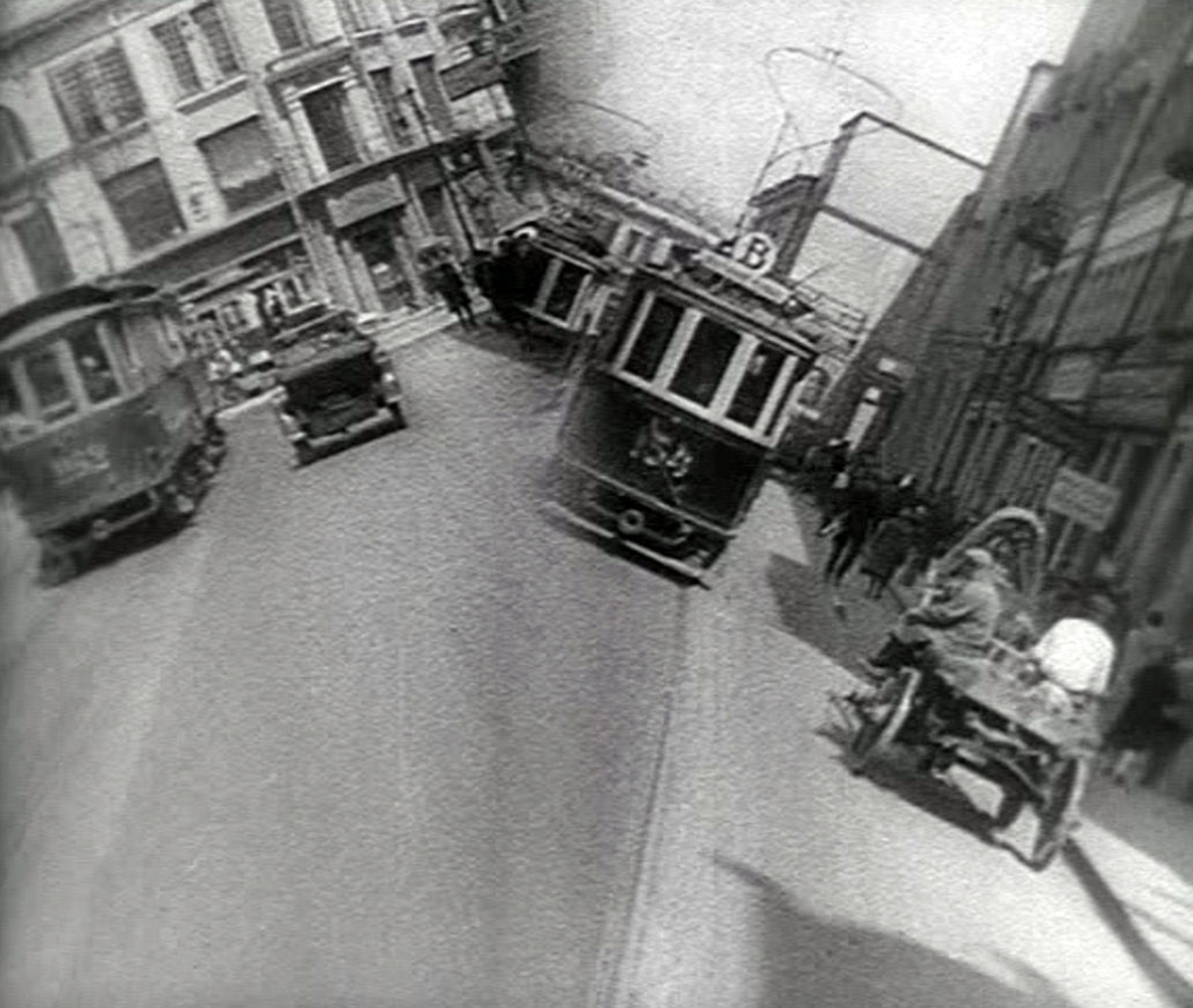
For Bordwell, this becomes problematic when films eventually abandon any depiction of actual continuity and turn into mere impressions of events, e.g. the fight scenes in the Jason Bourne movies. And I have always agreed with that. But Man With a Movie Camera is an interesting counter-example. There is a lot of deep focus throughout. A few extended tracking shots. But then the film has about 1775 different shots in its 68 minutes. There are a lot of close up shots of faces that quickly fade or edit over into something else. It kind of breaks all of Bordwell’s rules in its radical application of continuity across so many sequences.
But the difference is that Man With a Movie Camera is not an action film. It doesn’t intensify continuity because we might otherwise get bored. It isn’t trying to keep us munching on popcorn. For Vertov (and his editor), the speed at which the film transpires is necessary. It is the only way he can transmit his feeling that Soviet life was brimming with activity and vigor and promise. We move so quickly from young face to old face, industry to sport, car to horse, because this is the only way we can see it all in one glimpse. It is such an intense experience that one can really feel Vertov’s passion in every frame.
Overstreet:
And I think another difference is this: While the cuts come fast and furious, the content of the images are deeply connected, and we are asked to discern those connections. Sometimes they’re obvious – the thunderous progress of a train on tracks suggests the progress of the film through the projector even as it connects to the adrenalin coursing through someone who is in love, or the accelerated heartbeat of a viewer watching this movie. Sometimes the associations are more subtle, and they only occur to you on the second or third or twelfth viewing. Unlike Michael Bay, Vertov never appears to be suffering from attention deficit disorder. If anything, it’s the opposite. He conveys that he’s thinking so deeply and creatively that he’s making connections at an incredible rate. His epiphanies are happening so fast that they’re almost superimposed over each other on the screen.
•
Leary:
Critical writing on Vertov commonly notes that he is working here in 1929 full of hope and expectation for the great socialist project. It is easy to see this in Man With a Movie Camera, which celebrates the collective, the brimming industry, the elevation of equality. But this all a few years before Stalin’s regime really consolidated and Vertov’s vision becomes a faded myth. There is a fair sense of tragedy at play here behind the curtain of his biography that is important to consider regardless of one’s perspective on his political impulses.
Man With A Movie Camera
From this perspective, I am starting to think of Godard’s more recent films (Eloge de l’Amour, Notre Musique, and Film Socialisme) as burdened with a similar sense of tragedy. Godard has seen through and beyond the great political experiment that so captivated Vertov. But it is only through the lens of Vertov’s joyful observation of life and power and social innovation that I can really understand Godard’s cynicism as an important reflection on the previous century – and film history itself. What Vertov saw as a promising unity that connects the torrent of images contained in this film, Godard now bears witness to as a bunch of narrative and structural fragments.
Overstreet:
Yes, the grand experiment in socialism — well-intentioned as it may have been — failed. And yes, Vertov is clearly caught up in the thrill of a vision. But like most failed experiments, for all of the damage done there were flashes of inspiration and genius along the way, and they informed history in a way that would make future “bridges” reach farther, more beautifully, with the benefit of lessons learned.
When I watch Man With a Movie Camera, I can acknowledge that the forces of history underlying Vertov’s work were foreign to me… and flawed. But there is nothing at all wrong with the beauty of an image well-composed, well-captured. There is so much to gain from the revelation that no human being, no activity, no aspect of the world — natural or manmade — is ordinary. Everything is extraordinary when it is honored with this kind of intention.
Many years ago, a photographer I admire, Fritz Liedtke, sent me an excerpt from Richard Meryman’s book Andrew Wyeth: A Secret Life. It contained this quote from Wyeth himself:
“I think one’s art goes as far and as deep as one’s love goes. I see no reason for painting but that. If I have anything to offer, it is my emotional contact with the place where I live and the people do.”
Whatever his political views, Vertov’s “emotional contact” with a place, with a people, and with his chosen form of expression—his love for his subjects—is what enlivens this film. That sense that he is caught up in love with this city, and with the technology that allows him to capture it, will bring me back to watch this movie again and again.
