First impressions of Hamlet (2026)
Thoughts on the latest feature film version of Shakespeare's masterpiece — the significance of all it erases, the intrigue of its timely revisions.


The virtues of the great actor Timothy Spall have taken up my thoughts! They increase and multiply in abundant felicity! This splendid player, he doth move me as an artist tortured and ambitious (Mr. Turner); as a scowling military man assigned to monitor Princess Diana in Spenser; and as a stewed prune of a patriarch, wretched and cruel, in Wicked Little Letters. And, yes, he hath properly sickened my eyes as the felonious Peter Pettigrew in that most magnificent Harry Potter film concerning the prisoner of Azkaban. But oh, how he most moves me as large-hearted family man constant in all things (Secrets & Lies, my favorite of his films).
Okay, I’ll dispense with the repurposing of Shakespearean phrases here, and just say straightforwardly that Spall’s reimagined Polonius here, in director Aneil Karia’s newly reimagined Hamlet, is easily the most malevolent take on that character I’ve seen in at least a dozen productions of the play. In this supporting turn, Spall makes the most striking impression of the film’s whole cast. And that’s not a complaint about anyone else in the film’s small circle of players. He positively revels in the character’s wickedness here, playing Polonius as a guardian of Claudius’s dark dealings, sniffing along Hamlet’s trail and confronting him on more than one occasion with a fiendish grin.
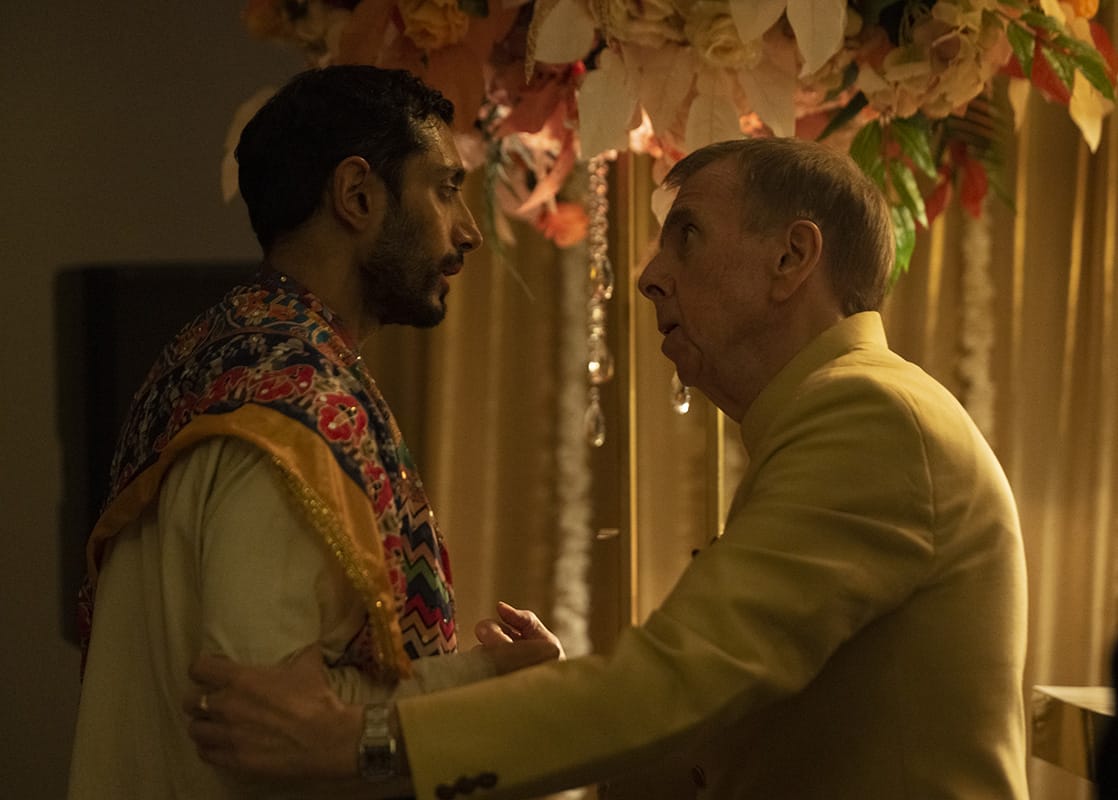
I remember playing Polonius in a few scenes in theater classes in college, and discovering in my rehearsals of his lines that, while he is often quoted as being wise, he’s something of an old buffoon, a windbag, wise only in his own eyes (or, better, his own ears). And he meets the ugly and unfortunate end that so many fools in theatrical tragedies suffer, collateral damage in a scene of misguided violence. So, I was alarmed to find that screenwriter Michael Lesslie has replaced the dottering rambler and his many famous (if ill-advised) aphorisms with a vile and insidious villain. What’s more, Polonius’s famous fate is grislier and more shocking here than in any adaptation I know. (If you know a worse one, show me!) Instead of feeling like a tragic error on Hamlet’s part, the king’s man falls like an agent of evil being struck down by a vigilante hero.
That’s just one of many ways that Karia and Leslie alter and abridge Shakespeare’s best-known text, an interpretation that lasts approximately 45% of the run time of Kenneth Branagh’s big-screen version. This version presents Elsinore not as a castle community, but as a real-estate empire, and Hamlet’s father as a CEO who falls victim to a corporate coup staged by Hamlet’s villainous uncle Claudius. This move will have devastating consequences on the street level, far below the towers of the rich and powerful, where a tent city and its poverty-line residents are sure to be soon swept away like dust. And all of this takes place in the context of Indian immigrants in London, still celebrating cultural traditions even as they surrender their souls to the corrupting influence of commerce and corporate culture ensure that “something’s rotten in the [real e-]state” of this version’s Denmark.

In this streamlining of the play we know and love, we lose face-and-name recognition for almost every character outside of the family circle. We’re left with Hamlet, his mother Gertrude (played here by Sheeba Chaddha as naive and much more tragic than usual), his uncle (a one-dimensional villain as played by Art Malik), and with two more essentials: Ophelia (Morfydd Clark, who simmers until she shatters) and a consolidation of Laertes and Horatio (Joe Alwyn, playing a variation on the sullenness and bitterness we saw from him in The Brutalist). We also lose Rosencrantz and Guildenstern. (But that’s not bothering me much, as they’ve been redeemed by Tom Stoppard in a play of their own that I love almost as much as I love the Bard’s own masterpiece.)
This 2026 feature would make an interesting entry in a “Shakespeare on Film” class for undergrads, one that gives students a variety of interpretations to compare and contrast. In my mind, this movie is not nearly as clever or as rewarding as Michael Almereyda’s contemporary re-contextualization starring Ethan Hawke, but far more cohesive and effective than Branagh’s predictably and self-indulgently extravagant all-star version.

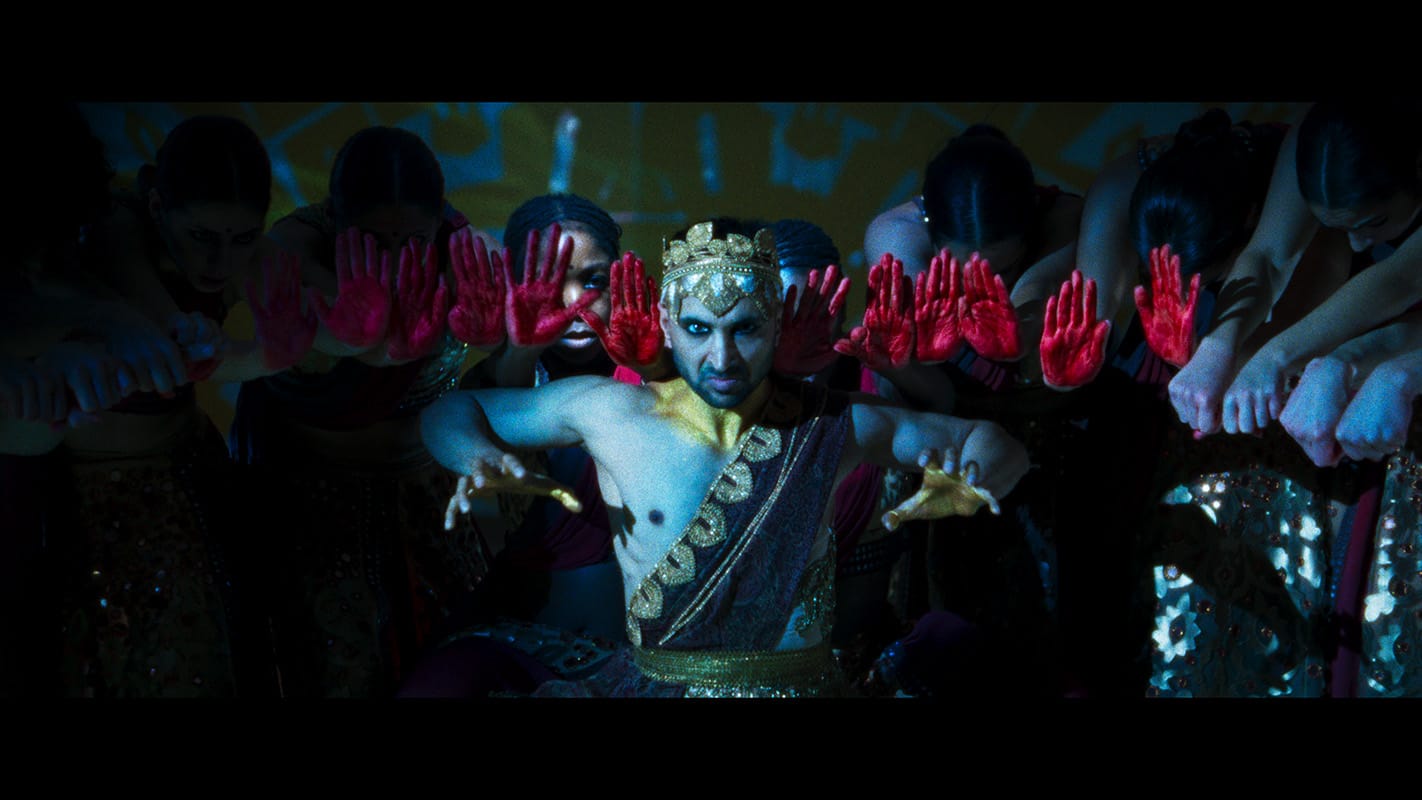
Among its finest flourishes, the film gives us what may be my favorite staging yet of The Players’ presentation to Claudius and Gertrude: A spectacular and eventually horrifying dance number, it’s the most visually enthralling scene in the film. (In fact, it’s the only visually enthralling scene in the film. I’d argue it’s the only scene that’s aesthetically interesting at all, the film’s visual imagination being its greatest weakness.)
And yet, even in this frenzied fever-dream of murder, framed to “catch the conscience of the king,” I’m dismayed by the elimination of my favorite moment in the play: the moment when we see the the king is not only frightened and troubled, but that his conscience has truly been caught. We don’t have the profound shock of hearing him cry “Give me some light!” We don’t seen him rush to any kind of confessional, which erases the character’s only truly humanizing moment. The result is a shallower Hamlet, one more intent upon the suspense of vengeful impulses and the catharsis of vigilante justice than on wrestling with the complexity of anyone’s character but Hamlet’s.
Still, I come to praise this Hamlet, not to bury it. We may not learn anything of Claudius’s conscience, but we can sense the filmmakers’ concerns about injustice. I can’t say it better than Scott Renshaw puts it in City Weekly, when he praises
the reinterpretation of Fortinbras—the play’s heir-apparent to the throne after the bloody end of Hamlet’s family line—as an activist collective of unhoused people, those most impacted by the actions of Hamlet’s father. Considering some of the Shakespearean poetry that is lost, it makes for a slightly less satisfying conclusion, yet it also makes for a different kind of hero’s journey for Hamlet himself, in understanding the need for turning over his father’s legacy to the poor.
Beyond that, what I find to be the most interesting result of the audacious revisions here is that we get a Hamlet who seems out of control and largely responsible for much of the damages that ensues after he discovers, in the early scenes, the injustices that have been done to his father, to him, and to the kingdom. (The fact that he is visited by the Ghost in the midst of a recklessly intoxicating night at the club introduces a troubling question: What if there was no Ghost at all? What if Hamlet’s madness is sparked not by a supernatural visitation, but by a delusion brought on by self-destructive tendencies?) The decision to film so much in discomforting close-up only accentuates how lost Hamlet is becoming in his own head, and how little he is actually investigating, how rarely he is thinking through the potential consequences of his decision decisions.
I’ve always believed that Hamlet is a tragedy not just because of what evils are committed at the beginning of the play, and not just because of the hero’s dismaying end, but because Hamlet’s mad passion — to bring about revenge and bloody justice here and now, in his lifetime, without leaving that matter to the Almighty — expands the blast zone of violence exponentially. His rage should seem to us problematic at least, and horrifying at best.
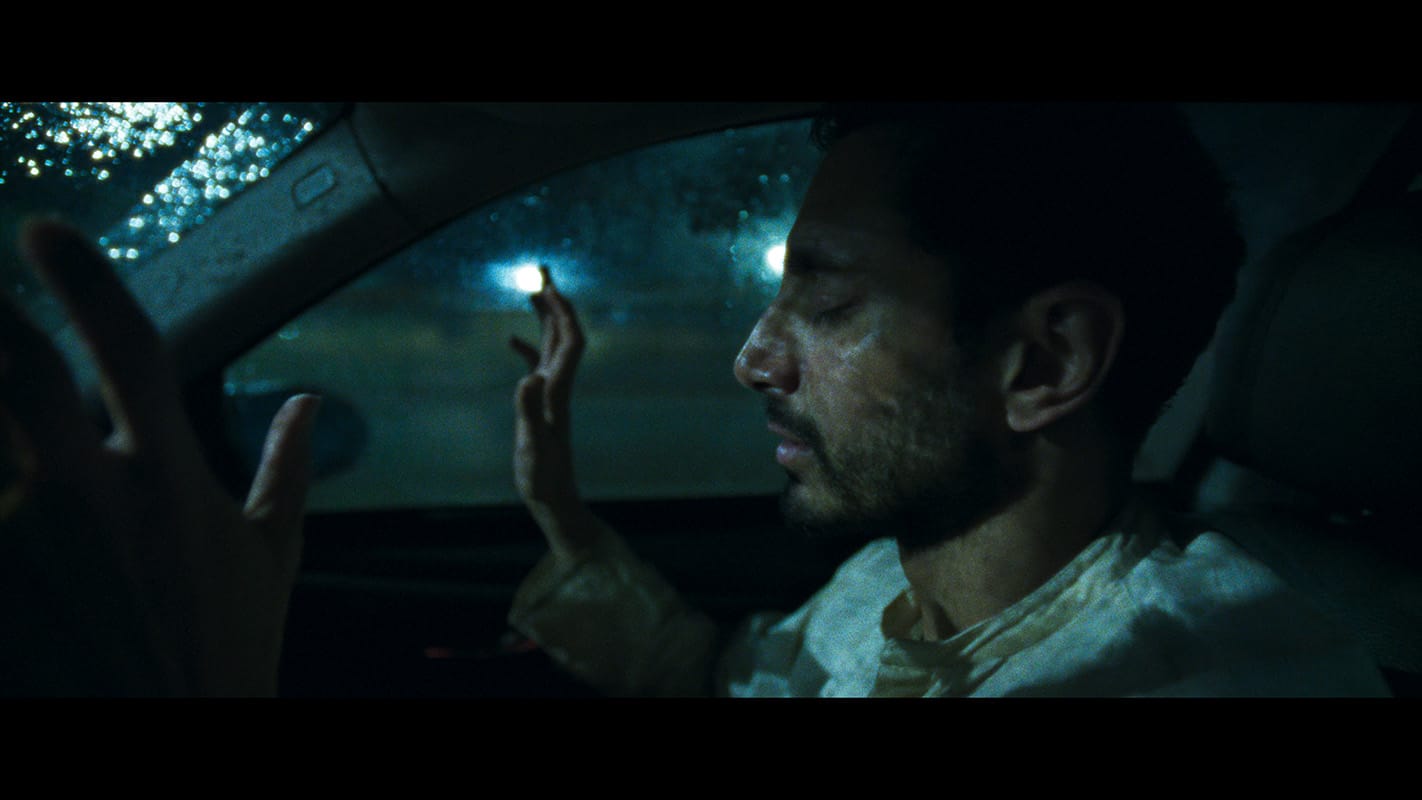
Riz Ahmed’s Hamlet is a hit-and-miss performance, as far as I’m concerned; but that’s not his fault. The filmmakers often leave him in rather uninteresting contexts to deliver the most famous monologues and rants. (His “To be or not to be” moment comes in a frantic scene of pedal-to-the-metal madness that feels over-the-top, but it’s certainly original!) But he has enough strong moments to earn his place among the best big screen realization of the character. He inspires empathy, sure; but here, his unhinged rampage seems more unsettling than usual. I think that’s healthy for audiences, especially in a time when so much depends upon our capacity to respond to great evils with a discipline of peaceful protest.
“Be wise as serpents,” the Scriptures exhort us, “and innocent as doves.” The how of that gets right to Hamlet’s madness, and underlines his most tragical failures.
It’s never occurred to me before, but now I’m sure of it. The decisive agent at the play’s bloody conclusion has to be iocane powder.