
REVISED: First (and second) thoughts on Kingdom of Heaven

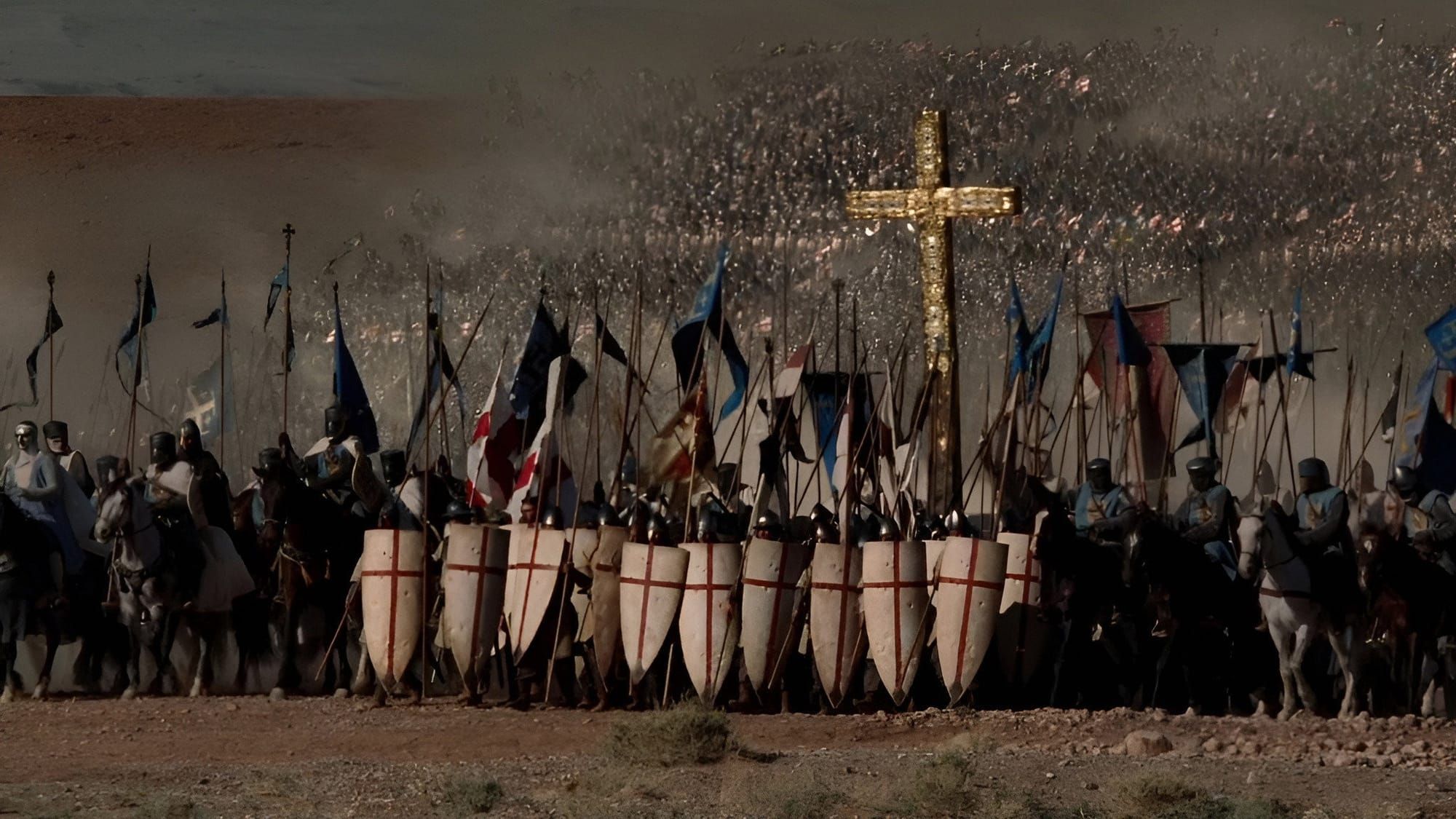
I saw Ridley Scott's Kingdom of Heaven today. I’ll write a review soon. But first, a few comments on how it fits into the trend of new “spiritual” films...
Better to call it Kingdom of Tolerance.
My initial reaction to the movie was negative. But the more I think about it (this post has been revised), I’m glad Ridley Scott made the film. It gives us a context rich with provocation that will spur viewers to investigate all kinds of questions... and we should focus on those questions. Whenever the film tries to lean toward an answer, it fumbles around and comes up empty, despite its good intentions. But forgive that initial, ticked-off rant. While I’m still dissatisfied, I’m seeing some of the film’s virtues more clearly now.
Kingdom of Heaven is a movie of and for our times, truly. It tries very hard to talk about a historical clash of Christians and Muslims without offending Christians and Muslims. It does this by portraying a wide variety of religious individuals, and by focusing on sins of arrogance and brutality in both camps while demonstrating little or no curiosity regarding their claims about God, their definitions of righteousness, or their concepts of holiness.
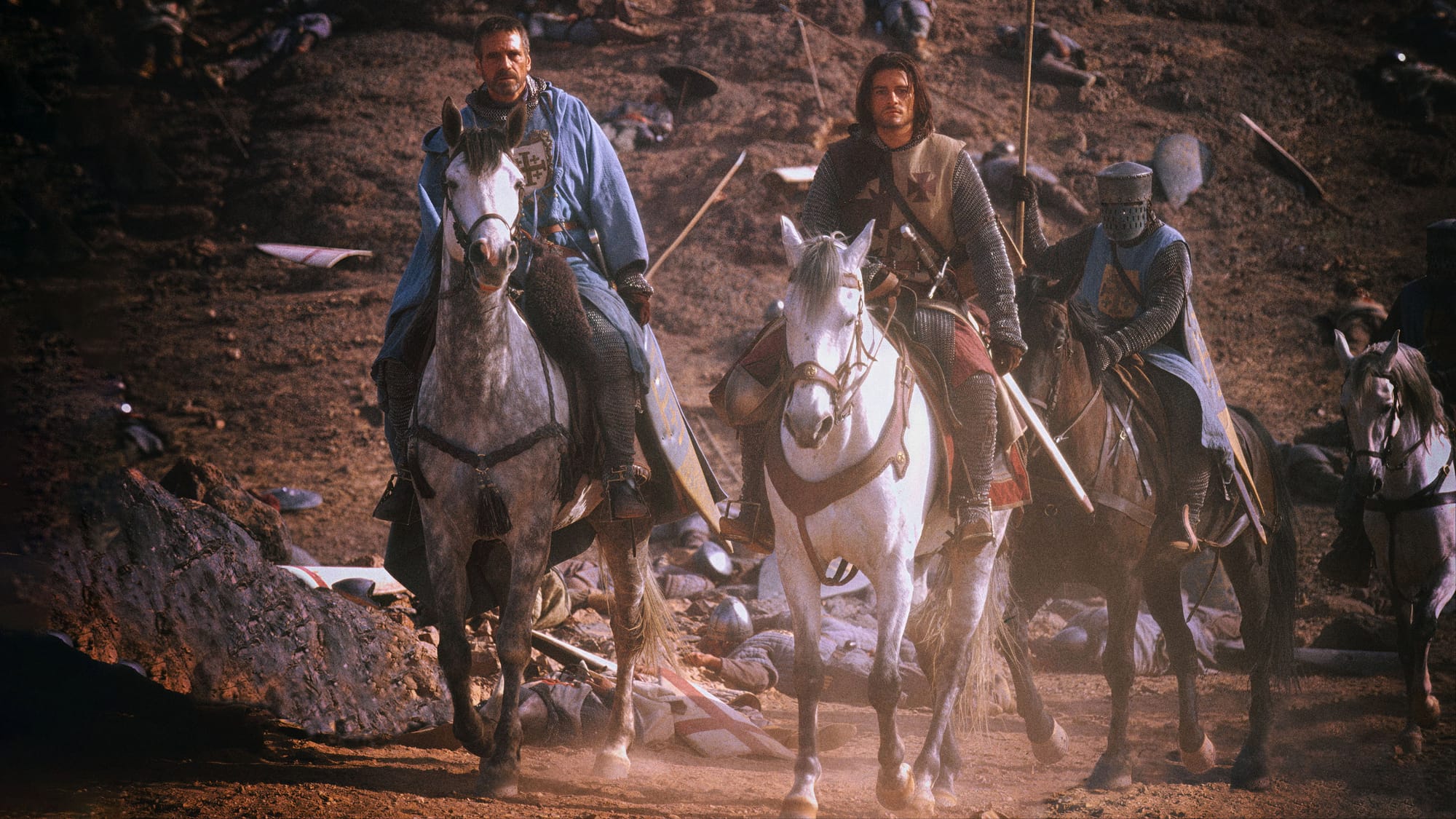
But it definitely has a message to people on both sides. And that message is this: Our highest priority should be mutual respect and cooperation, even if that means compromising or abandoning our religious convictions, because if God expects something of us that gets in the way of cultural harmony — that is to say, if God requires us to take up arms or employ coercive violence against one another — then he must not be God at all.
If this is, indeed, the film’s earnest suggestion, the irony is this: It sounds like Jesus, who refused to take up arms or employ coercive force, modeling nonviolence and a surrender to physical suffering, loving his enemies.
Further, Kingdom of Heaven suggests that, no matter what religion will tell you, the one true path of righteousness is the path of good deeds. Holiness is found only in a commitment to kindness, and to no ideal beyond that. That’s how it seems to be at this point, anyway.
In one memorable moment, Kingdom of Heaven’s hero declares that he is going to do something his way. If God has a problem with it, he says, well, then God’s not God. This strikes me as a crucial moment. Granted, the hero is following his conscience. Insofar as that is true, it is admirable. But I struggle with a sense that the film seems to think that the conscience is a sort of arbitrary and personal thing, something that belongs to us rather than speaking to us from beyond ourselves, rather than being a call to something greater than ourselves. I’m not sure. Does this film think that there is a Conscience that unites us all and draws us together? Or that the conscience is arbitrary and individual, and thus not a reconciling agent at all? Is there a Holy Spirit in this film?
Perhaps I’m asking too much of an adventure film. But when your movie keeps circling spiritual questions, we might hope that they guide us toward wisdom.
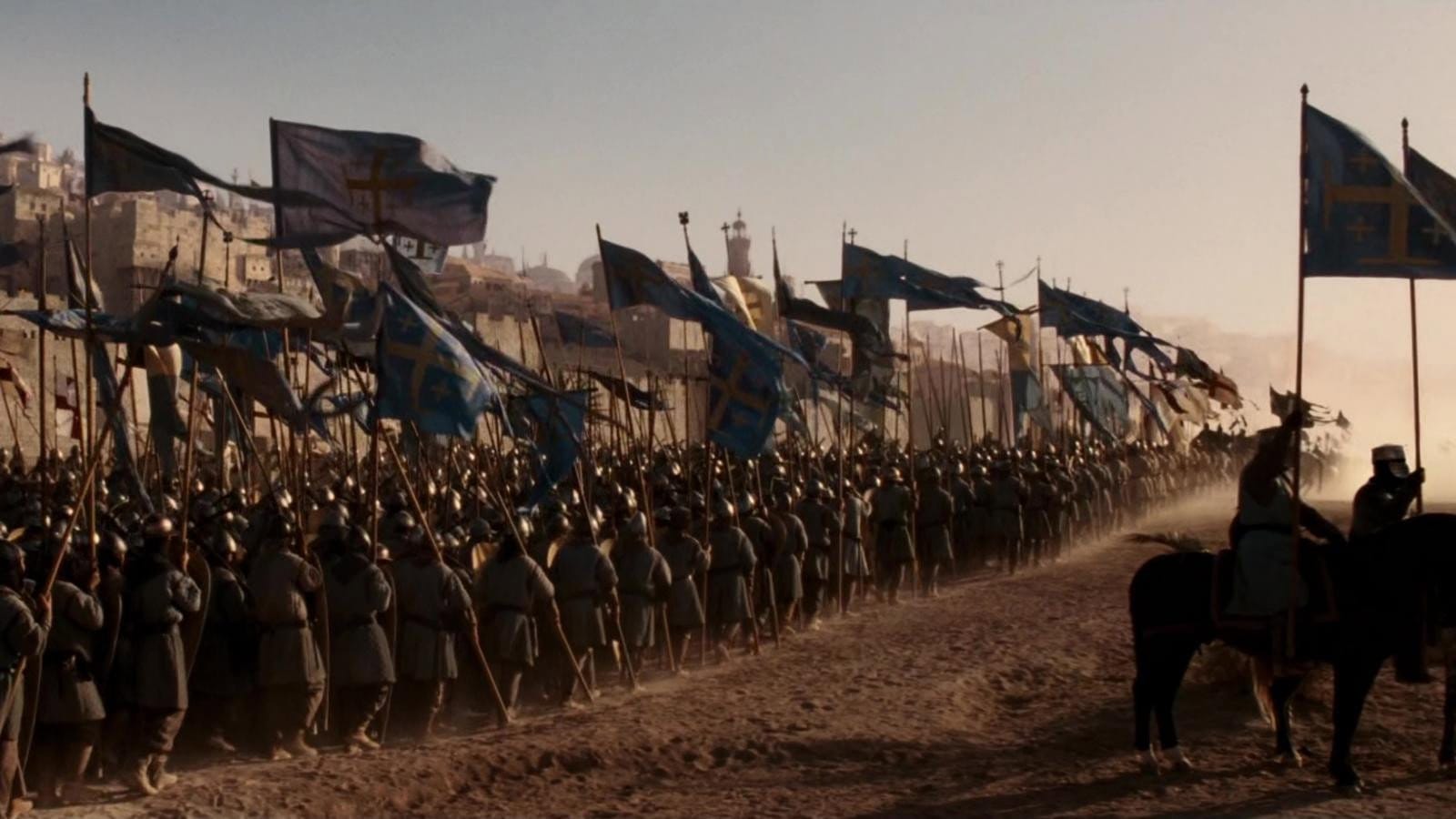
I shouldn’t be too upset that this movie doesn’t explicitly align itself with the Gospel. Ridley Scott is an agnostic and I’m confident the film wasn’t written or guided by Christians, so I’m glad the film turned out to be so thought-provoking. It’s not innocent, however, of an inclination toward condemning Christianity. Sure, Christianity in history has been guilty of all manner of crimes; the Gospel has been abused, distorted, and misinterpreted. But the film does not distinguish between those abuses, distortions, and misinterpretations and the Gospel at the heart of Christianity. All good things can be corrupted. Does that mean the good thing at the heart of it all is faulty?
Kingdom of Heaven’s recommendation for a better way falls far short of the mark. In trying to chart One True Path, it zigzags all around the Gospel and ends up feeling simplistic and desperate. Its circuitous path become an outline of Christ’s own example, and yet it never takes a step to consider that what it hopes humankind will aspire to is, in fact, an imitation of Christ.
The film breaks it down like this:
- There are Christians who make war in Jesus’s name and get it all wrong. And there are Muslims who distort their own religion and make war as well. [I find this to be true.]
- There are those who try to follow Christ, but when they don’t get their prayers answered, they despair and decide God has abandoned them. And there are Muslims who just want to get their way too. [I find this to be true, as well.]
- Christian leaders either become corrupt and wicked and devilish, or they become absolute buffoons who abandon their convictions at the first sign of challenge. Muslims, on the other hand... well, we don't get to know them enough to find any corrupt Muslims. They’re actually fairly admirable in their religious pursuits. [This strikes me as dishonest and biased. It disregards the possibility that the Gospel calls Christians to be loving and wise, and that Islam can be distorted and corrupted as easily as any other human construct.]
- But the best Christians and Muslims are those who realize that true righteousness is all about deeds... being a good man. Being a good man means knowing that your enemy is really just like you, and when all is said and done, there are really no differences between the two belief systems worth arguing over.
That last claim is the one that makes me choke. If the film really grappled with the different claims of the two religions it calls into question, the audience might have to face the fact that while these two belief systems have much in common, they have fundamentally contrary claims that are not reconcilable without substantial revision. As I understand it, one religion makes claims that equate righteousness and salvation with adhering to a code of obedience to sacred laws; the other, when received and understood, assures us of a salvation secured by God’s love mercy. There is no earning of the salvation by adherence to any law; Jesus insisted that this is the case. There is never any call to defend that religion with any violence; Jesus demonstrated this by example, even unto death.
I’m happy to see that Kingdom of Heaven is asking us to put up our swords and relate to each other differently. That’s a lesson that professing Christians seem almost incapable of learning, and any art that highlights this is inviting us on a meaningful journey. But the tendency to suggest that the best man is one who puts aside religion altogether for some generalized morality, that is insufficient to address most of the deep questions that lead us toward religion in the first place. (What is religion if not a an attempt to express, in some organized fashion, what is true, what is worth believing in, what wisdom might bless us all?)
Thus, Orlando Bloom’s hero is the messiah of the story by recognizing that making war is bad, protecting people is good, and doing good deeds is a sacred path (so long as “God” doesn’t complicate the conversation). The religion he arrives at in the end does not involve prayer or faith in any Higher Authority than his own determination. It makes of God a mere code, one devoid of mystery or agency or the capacity for even greater revelation. It doesn’t show any interest in where we come from, what lies ahead, or what might be moving us when we attend to beauty.
And what about the Muslims? The film paints them as people of honor and respect, for the most part. Oh, they have a few renegades who get what they have coming, but the movie carefully avoids showing us anything about Muslim culture that might invites us to consider its foundational ideas. One Muslim woman appears, but she’s abused by one of the Knights Templar, not by her own people. So, Christianity’s cultural and historical oppression of women is, by implication, condemned, while Islam’s interests on that matter are ignored.
Overall, Kingdom of Heaven is a well-made film, another fine example of Ridley Scott’s stellar craft. It has strong performances from its cast of great actors (Bloom isn’t bad either). I’d especially point out David Thewlis, for an admirably restrained turn. (Finally, directors are rediscovering this great actor.) It’s great to see Jeremy Irons back in a role of authority and dignity (until the end, when his character abruptly disposes of that intelligence and strength). Eva Green is striking and surprisingly effective as the princess. (But of course, Bloom’s character quickly disposes of any ethical hesitation in sleeping with this married woman.) And Brendan Gleeson is once again a ferocious, commanding screen presence.
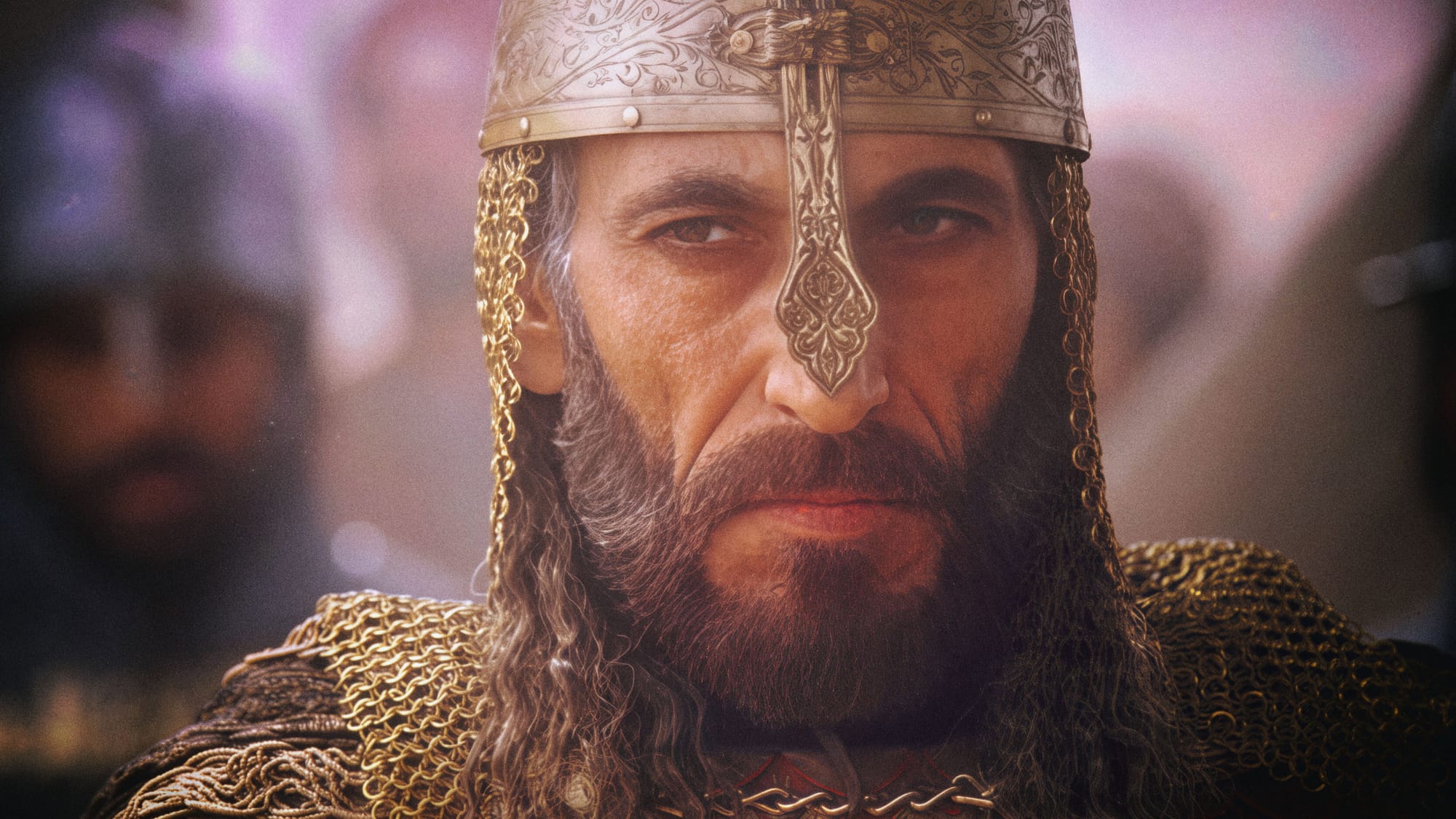
Best of all is Ghassan Massoud as a magisterial Muslim warlord named Saladin; he steals the show whenever he’s on screen.
Further, the film boasts Scott’s typically dazzling cinematography. But one of the surprising disappointments is that this established master of adventures and epics would exhibit such a lack of creativity in the battle scenes — Scott basically clones dozens and dozens of shots from The Two Towers and The Return of the King.
The greatest disappointment is that the storytellers seem to think the Muslim way and the Christian way are equally misguided, and that there is a secular path that trumps both of them. This makes it, ultimately, a hollow piece of cultural commentary.