
Jane Eyre (2011)

Dear Anne,
The new Jane Eyre makes me think of you.
For several reasons.
I know you love the 2006 BBC mini-series and I wonder what you’ll think of this. Cary Fukanaga’s two-hour sprint through the book will probably frustrate those who love Charlotte Brontë’s epic; it really needs a series-length treatment. Nevertheless, I’m impressed with his paraphrase. Give it a try.
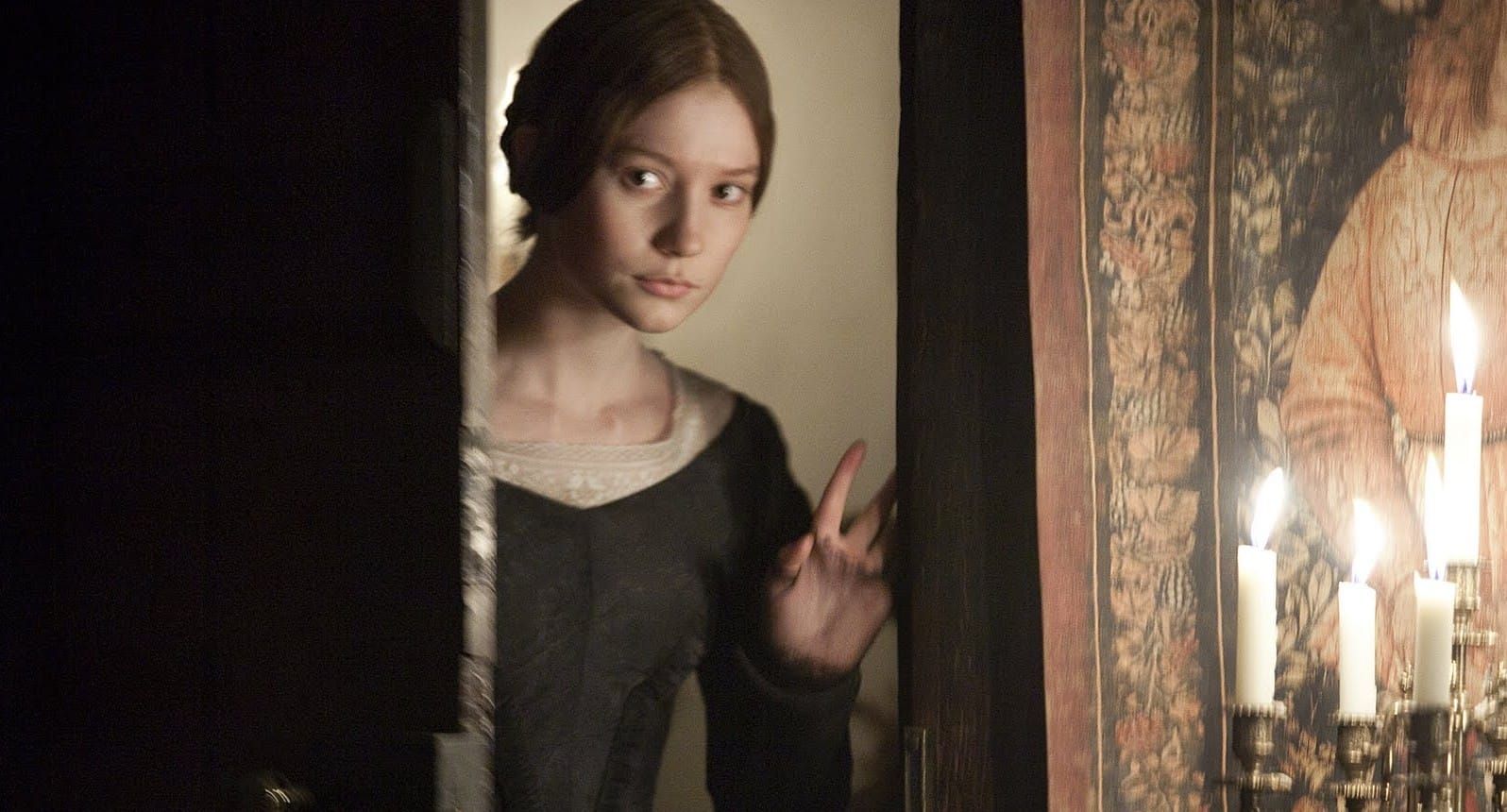
You admire Ruth Wilson in the series because, glamorous as she can be, she’s convincing as plain Jane. You’ll admire Mia Wasikowska too. Despite her new Hollywood “It Girl” status, Wasikowska seems right at home as a modest 19th century governess. (A friend noticed Wasikowska’s resemblance to the famous photograph of Emily Dickinson.) As she brings Jane to life, I see why so many directors are drawn to her. She got lost in the circus of Tim Burton’sAlice in Wonderland, but here her subtle expressions are revealing.

You’re also fond of Toby Stephens, the miniseries version of Brontë’s “ugly” Rochester. I think you’ll also accept Michael Fassbender as the tormented but wealthy master of Thornfield manor. He’s far too handsome—when his face filled the screen, I heard so much sighing and swooning in the theater that I feared we’d lose our oxygen—but then, Stephens wasn’t exactly revolting, was he?
This adaptation has problems. It downplays Rochester’s past promiscuity. We don’t hear him speak of his past mistresses as he did in the book: “Giacinta was unprincipled and violent: I tired of her in three months. Clara was honest and quiet; but heavy, mindless, and unimpressible: not one whit to my taste.” And the movie seems nervous about the mad woman who lives upstairs at Thornfield, as if her presence might disrupt the audience’s fondness for Rochester.
Some Christian film critics are incensed at how many religious references are missing. It’s true—you won’t hear anyone say “I thank my Maker, that, in the midst of judgment, he has remembered mercy,” or “My heart swells with gratitude to the beneficent God of this earth.”
But Jane’s faith and ideals are plain to see. While many classics are revised to treat religion as a pestilence and marriage as a prison, these filmmakers honor faith by painting those who distort it as villains, and those who embrace it as beacons of hope. Jane’s desire for a good marriage sanctifies the ideal for the audience.
Furthermore, Fukanaga refuses to demonize villains, and when they fail, he doesn’t let us savor their misery. We grieve with Jane when they refuse her gestures of forgiveness and grace.
The film is also beautiful. The colors and compositions recall the haunting beauty of Jane Campion’s The Piano, which found a similar tension between the chaos of the wilderness and the constricted energy of a highly mannered society. Wasikowska’s countenance, plain as they have made it, is enchanting in the film’s frequent candlelight.
This is Jane Eyre’s twelfth feature film. What makes her so irresistible? She’s compelling even though she’s surrounded by striking, comical, and grotesque supporting characters who should be far more interesting. Normally, straight-and-narrow heroes are dreadfully boring. Even Jane Austen’s Emma, lovable as she is, makes interesting mistakes.
Miss Eyre is almost too good to be true.
Fukanaga treats her like a saint. As a child, when she’s unjustly accused and made to stand on a chair to be mocked, Fukanaga films from the floor so that the suffering Jane is raised up, a silhouette against a bright window, an icon in a cathedral. Her angelic friend Helen, who tells her that she’s surrounded by benevolent spirits, has a face framed by golden hair—the film’s most vivid color. Christ-like, Jane stands on borderlines between children and adults, rich and poor.
Even her name suggests sainthood. Brontë might have meant Eyre as a reference to money Jane would inherit. But isn’t it more likely to remind us of the beatitudes? Jane is meek and poor in spirit, and as such she’s the “heir” of God’s blessings—a beauty among beasts.
Which brings me back to why I thought of you, Anne.
Our mutual interest in fairy tales—especially variations on “Beauty and the Beast”—has led me to see that story everywhere. But here, the “Beauty” of the story may not be Belle, the voluptuous virgin who slowly agrees to love a mournful monster. (That story always struck me as a male storyteller’s ploy to convince the object of his affections to forgive his flaws.)
Perhaps the beauty is something higher—the sacred ideals that inspire Jane and draw Rochester into the same light. A sin-scarred man casts off shame, a pious woman casts off her fears, and they’re united in grace.
They’re also joined by an appreciation of aesthetics. He’s dazzled by her drawings, which capture “the shadow of her thoughts.” She’s impressed that he notices her and values her opinion, when he could win much “fancier” women. Their shared practice of eloquent banter, and their desire for a marriage of integrity, set them apart from society’s shallow pursuits.
I relate to this, somewhat. You drew my attention through the quiet poetry of your personality and work. We became acquainted by reading and critiquing each others' stories and poems. You “transfixed me quite” with your verses, which taught me to slow down and look more closely. I’m still learning from your example of eloquence, attentiveness, and art.
I don’t have a past full of mistresses, nor do I imprison a mad woman upstairs. But I’ve made plenty of humbling mistakes that have cost us both. You show such patience and longsuffering through my dark moods and my failures. I’m a man whose appearance is less than ideal, with no estate to speak of, grateful that a woman whose heart is as strong as her intellect has chosen to live by my side.
But you’re different than Jane Eyre in this — you’ve never looked anything less than extraordinary to these eyes.
Yours,
Jeffrey