
Revisiting The Dark Crystal
Since I was 12 years old, The Dark Crystal has had a strong influence on my imagination. Looking back, I find that it seems more profound than ever.

Sometimes the movies we loved as children look very different to us as adults. We might be embarrassed that what we loved like it was the best thing in the world now looks shoddy, pandering, sentimental, derivative. I remember a time when The Rescuers was my favorite animated movie; now I regard it as a whimsical but second-rate Disney feature. I remember arguing that the movie The Secret of NIMH was better than the book; now I wonder why the storytellers felt compelled to add seemingly arbitrary magical elements to a story that was stronger without them. We grow. We learn. We develop more complex frames of reference. We become more discerning about standards of excellence. And we learn, hopefully, to restrain ourselves before jumping to conclusions and making vainglorious pronouncements.
I hear people laughing about the awfulness of The Dark Crystal so often that I wonder if I’ll cringe the next time I see it. Almost everyone agrees that the puppetry and sets are extraordinary. But then they talk about how creepy it is. (It is!) And how it plays for children like a horror movie. (It does!) They talk about how feeble the storytelling is. (Well, perhaps. It feels more like the scaffolding of a story with extravagant production values draped over it.) And critics lament that the protagonists are just types, not fully developed characters. (They have a point.) They mock the heavy-handedness and mundanity of the dialogue. (I do, sadly, have to agree with them.)
Yes, all of these things could have been stronger — much, much stronger.
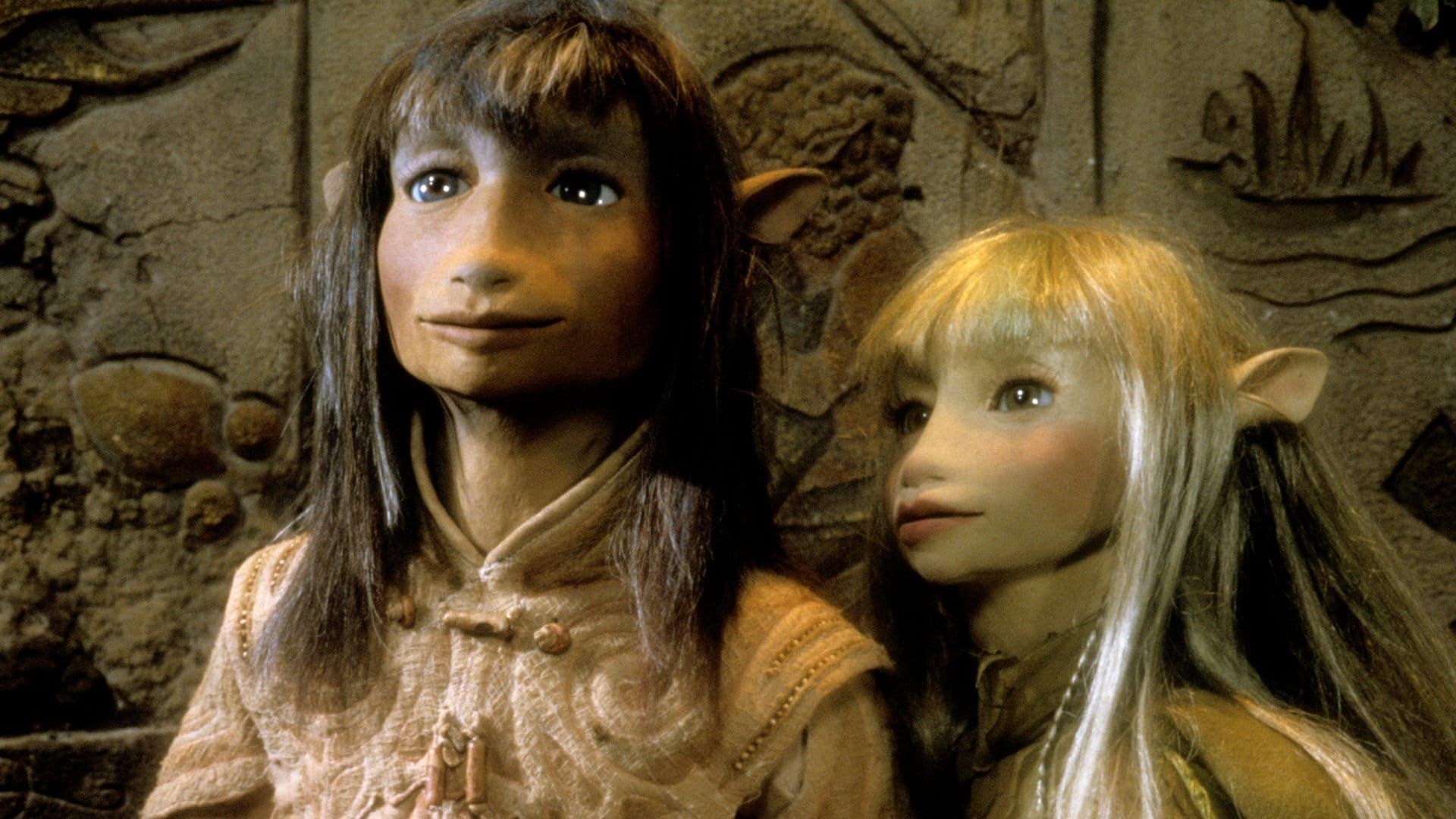
But what works really, really works. Puppetry is an art. The magic of puppetry is that if the puppet is well-made and well-performed, it comes to life in a way that we quickly accept and believe in. Great puppets, performed by great puppeteers, live in our imaginations with the specificity of any great actor. They can make us care about them and their worlds. They can haunt us. Even the simplest puppets — consider Kermit the Frog, or Lambchop, or Fred Rogers’s King Friday, or even Triumph the Insult Comic Dog! — can suspend our disbelief in the hands of master puppeteers. Both the puppetry and the elaborate, fantastical environments of The Dark Crystal suspended and sustained my disbelief when I saw it as a child. They still do.
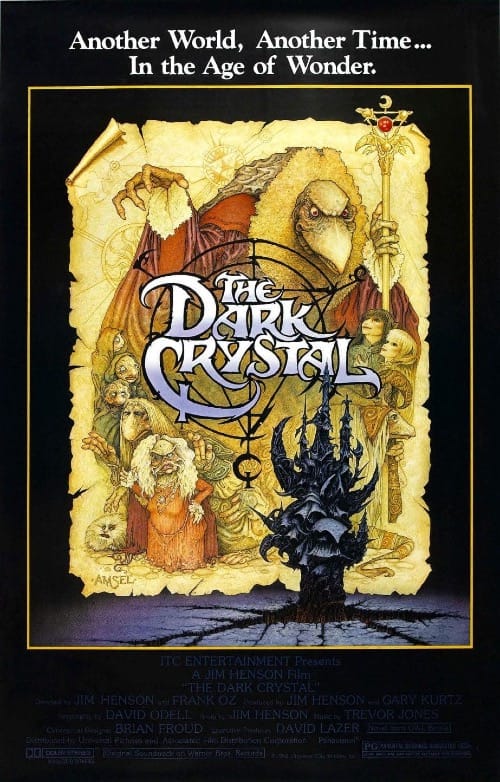
Jim Henson was, more than any other artist, entertainer, or celebrity, my childhood hero. I have a whole chapter in my new book that serves as my letter of gratitude to him for how he changed my life. When I learned, at age 11, that he was about to introduce us to a whole new fantasy world, I could hardly contain my excitement. And when a movie poster arrived in the newspaper — in full color! — I began learning to draw it myself in intricate detail as a coping mechanism for the long wait until the film arrived.
And when it arrived in December 1982, and my father took me to see it at Portland’s Mall 205 cinemas, I was enthralled. Dad? He regretted his decision; it was obvious to me throughout the movie that he was absolutely miserable throughout the experience. (Dad never showed any interest in fantasy, nor much interest in movies. He avoided anything with violence, anything scary. And when it comes to dark fantasy, The Dark Crystal goes hard.) By contrast, I could not wait to get home, learn to draw the characters, and write a story of my own inspired by this one. Within a year’s time, I was putting on a puppet show for other children in the neighborhood, a fantasy story called Quest for the Enchanted Stone. Elf-like heroes, raptor-like villains, a bloated monster who was also a benevolent witch, and a magic stone that could save the world — it was clearly an imitation of The Dark Crystal.
As the years passed, I did not lose interest in The Dark Crystal the way I did with so many other fantasy and sci-fi films like Ralph Bakshi’s animated The Lord of the Rings or Disney’s The Black Cauldron, and Ralph Bakshi’s The Lord of the Rings. I grew to love it more. Sure, I grew to recognize its weaknesses. And the narration became something to endure. (“And so... Jen began his journey. The journey... of Jen!” Seriously, how could anyone have allowed such lines?) But there was something deeper going on in this story, something that stood out in sharp contrast to other fantasy stories I knew — and that included Star Wars, another fantasy that preoccupied my religious imagination. I remember feeling a flush of anger and defensiveness when Christian media voices protested The Dark Crystal as threatening moviegoers with “New Age” and “occultic” ideals. It would take me a long time to find the words that I needed to express what the film meant to me — and still means to me — and why.
The Dark Crystal remains, in my estimation, the greatest achievement in feature-film puppetry — rivaled only by The Dark Crystal: Age of Resistance, the Netflix television series that brought us back to and built upon the foundation that Henson established. (And that series has impressive screenwriting, complex characters, and much more sophisticated storytelling.)
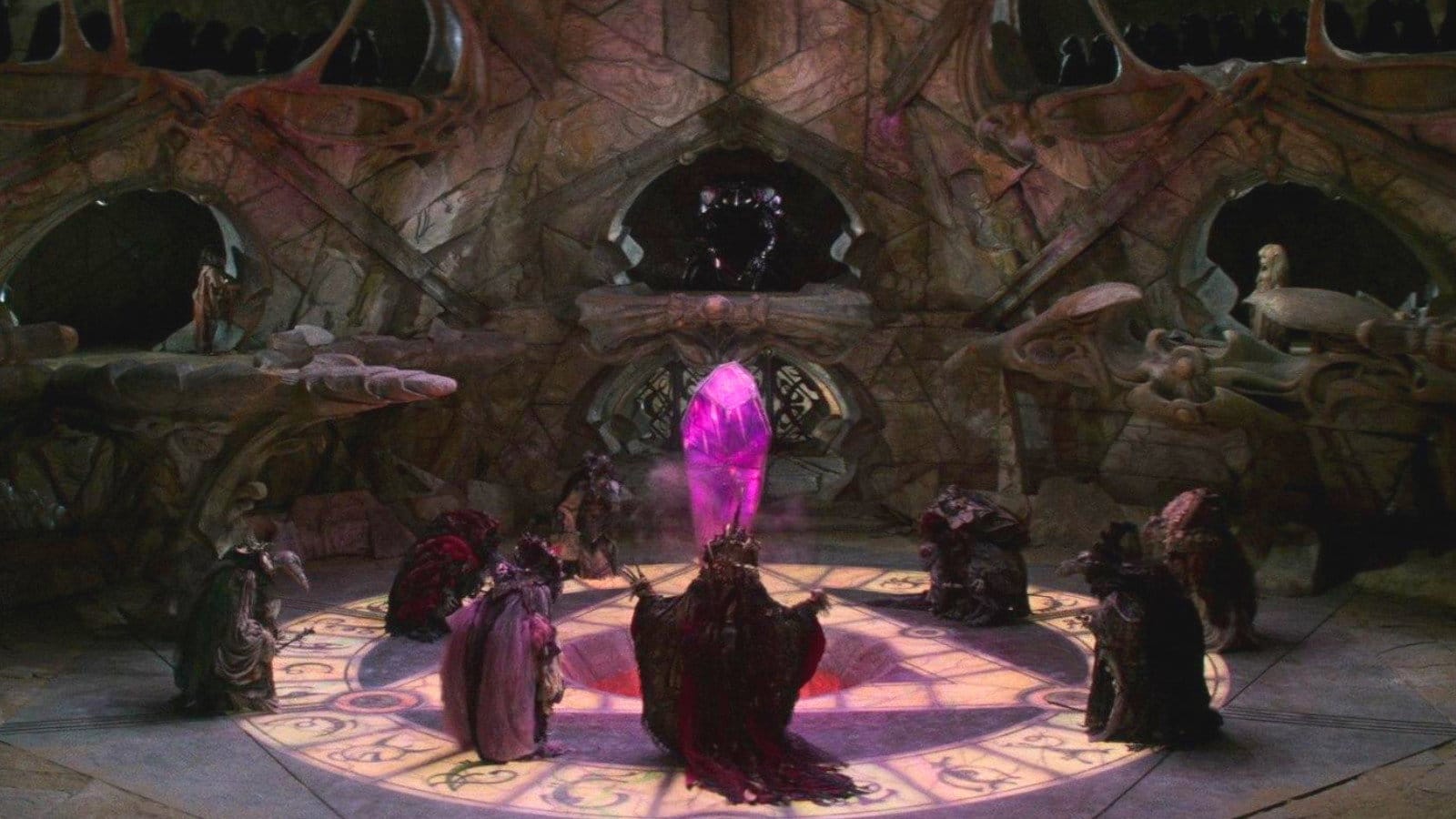
The magnificent movie poster produced by the legendary poster artist Ansel for the film’s original release looms over my desk at Seattle Pacific University and sparks students’ curiosity (if they don’t know it and love it already). Something about the unsettling lifelikeness of the monsters designed by Brian Froud kindles sparks of creativity in me every time I look at them. I recognize these monsters somehow, on a very deep level, as if my own fears have emerged from my nightmares during the night and now lurk in the world. I recognize the wilderness flourishing with strangeness — plants that look like animals, animals that look like plants, and crisscrossing currents of music emanating from birds and bugs and god-knows-what.
Last week, I had a rare opportunity to see a one-of-a-kind, fan-edited, extended edition of this film. It’s an impressive accomplishment by someone who knows what they’re doing. The Dark Crystal is a movie that deserves a special edition. And since that’s unlikely to happen, I’m grateful for resourceful fans who have invested time and cleverness in coaxing the version we have closer to representing the version that Jim Henson, his co-director Frank Oz, and their co-producer Gary Kurtz (who produced Star Wars and The Empire Strikes Back), intended to show us.
Henson’s vision and David Odell’s screenplay were, in the theatrical cut that most people know, severely compromised. They wanted the Skeksis, those terrifying and fearsome dinosaur-bird villains, to speak in their own language, one created specifically for the film. Regardless of whether that language was based on ancient Egyptian or Indo-European roots (claims differ), that sinister dialogue was recorded and applied to the film. The humble Podlings spoke in another original language, once based on Serbo-Croatin. But test audiences complained about the unfamiliar languages, and so Henson and company replaced the Skeksis’ ferocious voices with English dialogue, dialogue that was hastily composed and badly incorporated, oversimplifying things for temperamental and reactionary audiences.
This cut restores recordings of the Skeksis terrifying, guttural, splattering speech. And it does not bother with subtitles either. Surprise, surprise... it works! We can discern what’s going on. We’re not missing out on anything.
This cut also restores deleted scenes that give us a wider, wilder engagement with the extravagant world that Henson, Oz, Kurtz, and Froud brought to life — including scenes that dramatize the funeral ceremonies for two important characters. This allows for the incorporation of even more music from Trevor Jones’s spectacular score, one performed on one-of-a-kind instruments that were designed to belong in this world. (There’s a lot more music served up on the outstanding, 3-disc, 40th anniversary edition of the film’s soundtrack album than we get in the 93-minute theatrical cut of the film! I encourage you to seek out that multi-disc set, which features an outstanding booklet full of historical details and quotes from the filmmakers, written by the great film-score journalist and historian Tim Greiving.)
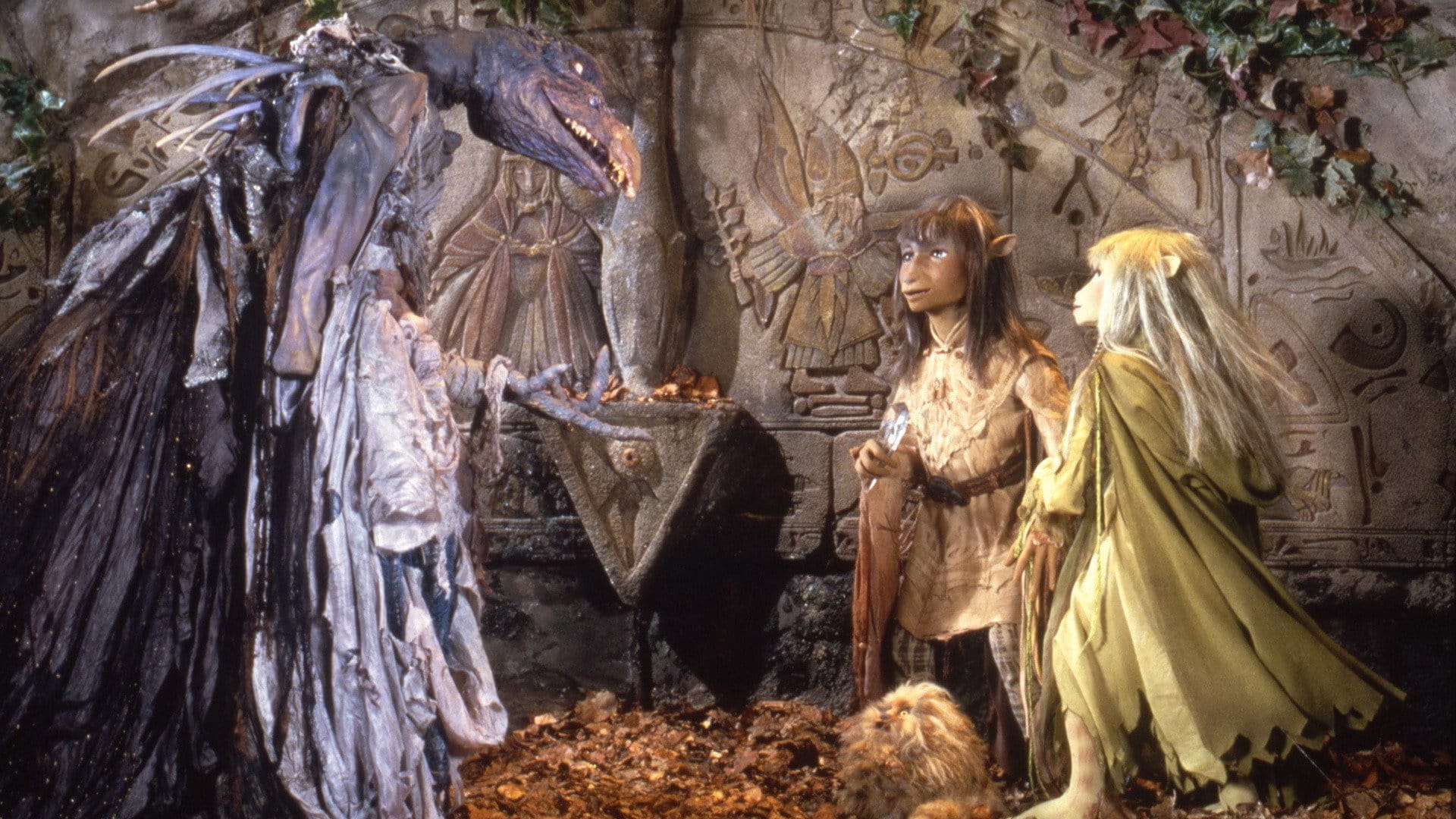
The good news? This fan edit is likely the closest I’ll ever get to experiencing this the way Henson intended. The bad news? It’s a fan edit, shared friend-to-friend. You’re not likely to have access to it.
What it means to me now
I was moved once again by this most singular of fantasy stories in which the conclusion is not a triumph of good guys over bad guys — not in the sense that the good guys win by blowing up the bad guys or shooting them down. It’s a triumph of good over evil in that it brings about a reconciliation of sorts — a reunion, a healing of cosmic wounds.
The story goes that celestial beings were fractured into dual, dueling populations: the kind-hearted and wise Ur-ru (otherwise known as The Mystics) whose every maneuver seems weighed down with grief; and, the malevolent power-mad Skeksis, who literally wring the life out of the small and the vulnerable, and then drink those “precious bodily fluids” (to borrow a phrase from Dr. Strangelove) like the water from a Fountain of Youth. Resolution in this paradigm is about bringing back together what has been torn asunder. In this, I discern a truth that runs counter to the self-aggrandizing adventure stories that are prevalent in pop culture, stories in which victory looks like glorifying those we would identify with and annihilating those we oppose.
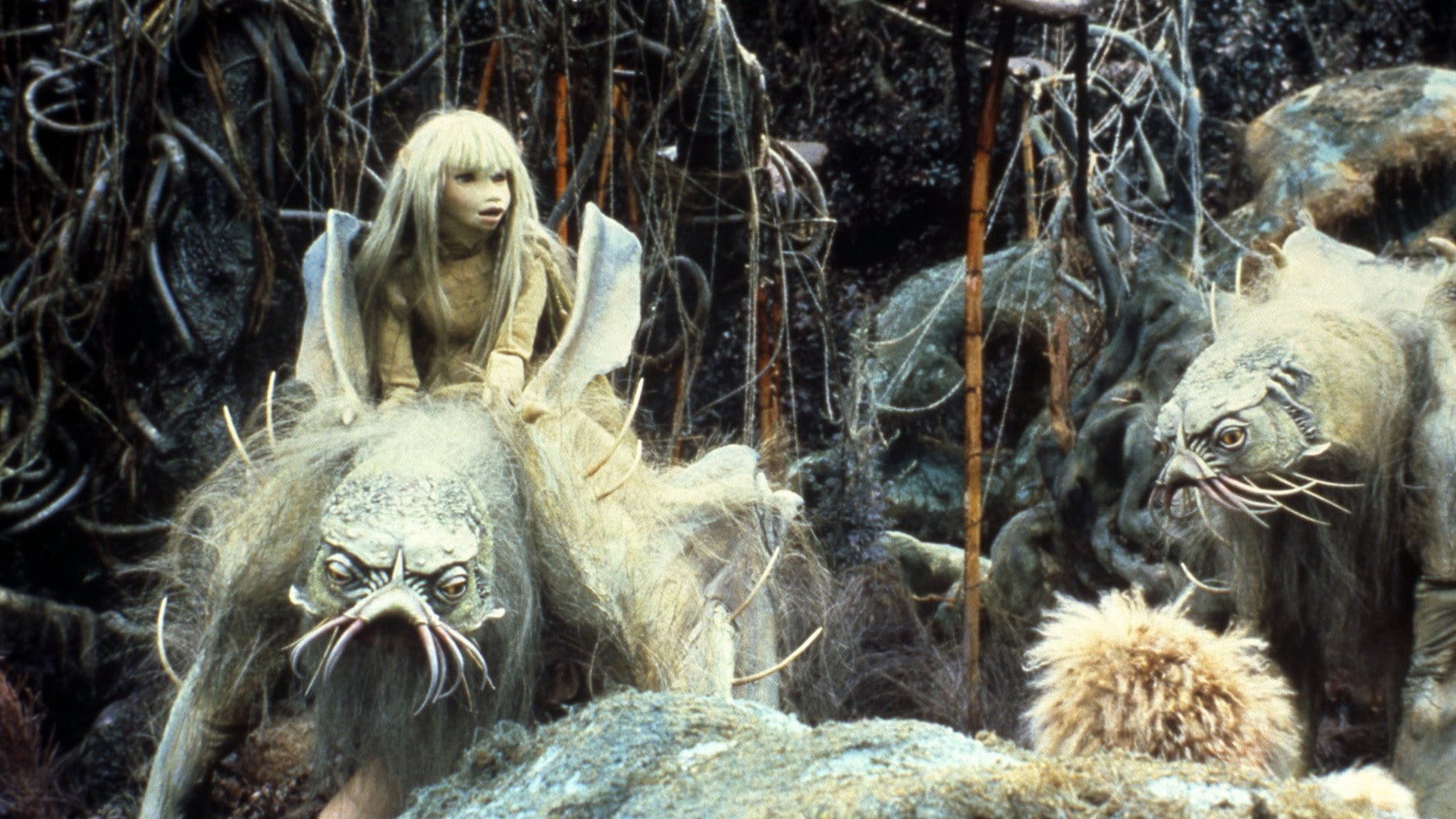
I don’t believe in good guys and bad guys. Sure, there is no shortage of humans whose behavior is appalling and depraved — and they are often the humans who are convinced in their own minds that they are “the good guys.” But I believe the whole human race is a mess, a mess of ignorance and destructive impulses that we cannot fix ourselves. Those of us who strive to walk the path of love, we aspire to be like the Mystics — dedicating ourselves to kindness, gentleness, generosity, justice, and grace. Many of us believe in prophecies of restoration. Those who succumb to their darker energies become like the Skeksis, driven by fear and hatred to strive for power. It’s not a matter of won defeating the other. Both species need restoration.
If we’re honest, we live somewhere on a spectrum of these inclinations. And we might also identify with the Gelflings, a humble and resilient race like Tolkien’s hobbits. The wicked, wretched Skeksis have sought to destroy Gelflings because of prophecies that these simple folk will bring about their undoing. Jen and Kira, the only two remaining Gelflings (as far as we know), must quest to piece back together a magical crystal, a purple monolith that fractured the cosmos when it cracked. If they succeed, the world will undergo an apocalypse in which Ur-Ru and Skeksis will become one again.
Whenever I watch this drama unfold, I feel the bone-deep truth of it.
Brace yourselves. I’m about to get fiercely theological and, if you will, religious about The Dark Crystal.
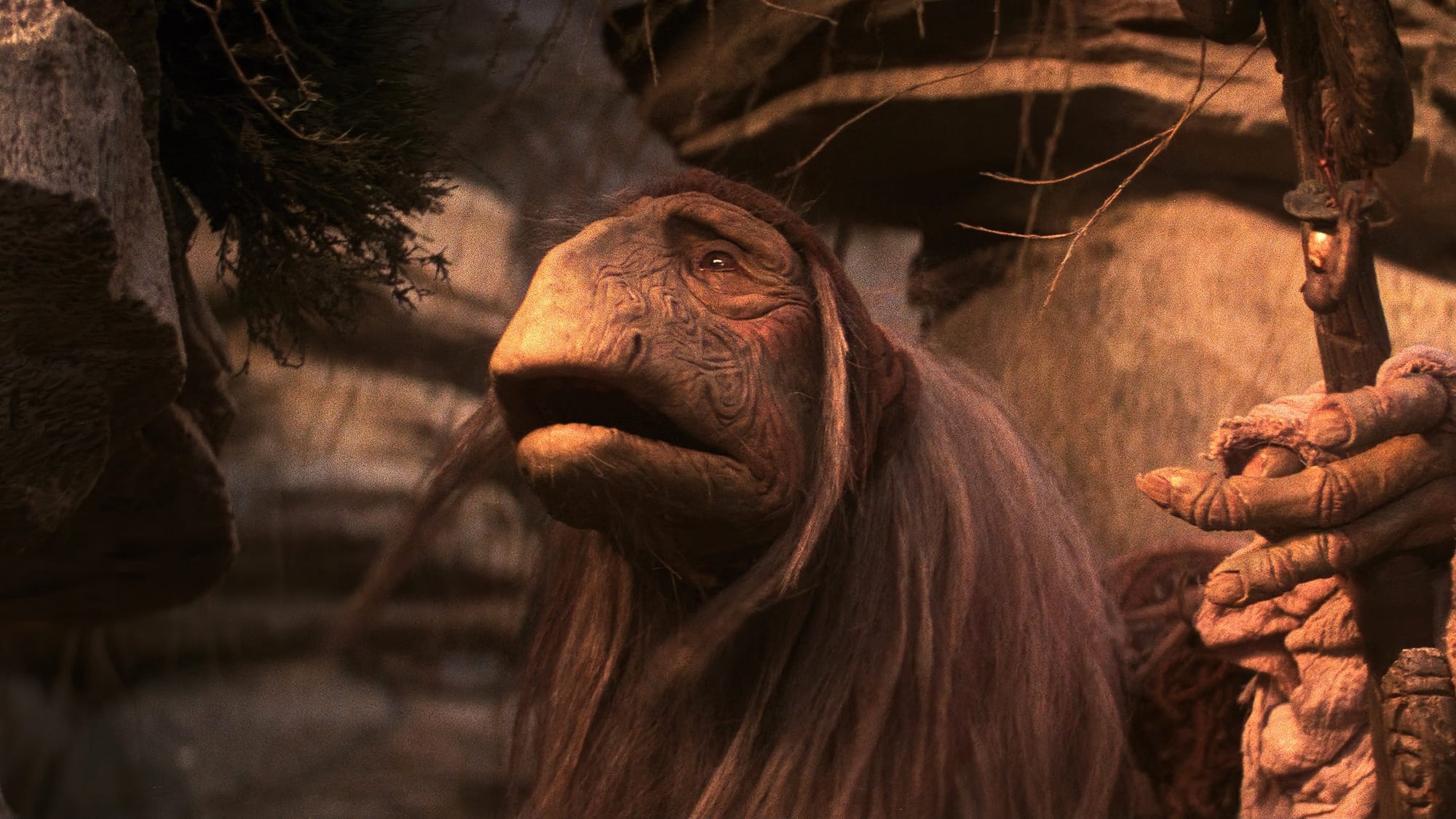
The world is not a place that can be divided into the good guys and the bad guys. Only Love (that is what I mean when I say “God,” by the way), only that wild dance of boundless generosity and mercy and creativity, is truly righteous. Love is an activity, a way of being. All of us fall short of Love’s high standard.
And thus, I am increasingly convinced that the only salvation worth believing in, the only one worth hoping for, is the forgiveness and salvation of all — ourselves and our enemies alike — through reconciliation and restoration. If God commands us to love our neighbors and to love our enemies, does that not mean that God loves those enemies and is intent on pursuing them for redemption? If God is Love, what else should we expect?
How catastrophically the Christian church has lost sight of this vision. How grievously they betray the savior they claim to believe in by preferring and arrogantly idealizing a binary paradigm. Having decided that they have the Code by which they can judge who is saved and who is not, they count themselves as the Lucky Ones whose dreams come true and they live happily ever after. And they count innumerable children of God as condemned to everlasting suffering. (These are, conveniently, those the church deems guilty by the measure of selective, strict laws they have constructed on top of Christ’s Gospel of grace.)
The Dark Crystal’s cosmology stands in stark contrast to such binaries, such models that require the annihilation of their Creator’s children. Jesus, too, vocabularies of damnation. Sure, the Scriptures speak of Hell. And these are difficult passages that seem contradictory to a gospel of Grace that promises to save all of creation. Increasingly, these passages sound to me like they refer to the depths of misery we bring upon ourselves when we turn away from Love. Jesus revises our conception of a wrathful God who lashes out at sinners, saying that suffering is not inflicted on us as a judgment for our individual sins. (Those who suggested such things to Job in the Old Testament were portrayed as sorely mistaken.) Jesus corrects our vision through his own suffering. His persecution and his miserable, gory death are surely not judgment on any sins of his own; he demonstrates that all of creation moves through the valley of Death’s shadow. And once through it, we find that Christ has been with us every step of the way, drawing us up into the resurrection he revealed to us.
The Scriptures promise that every tongue will, in time, name Jesus as Lord. And those who do — that is, everyone, in time — are saved from the hells of their own making. Jesus’s victory over death means that there is nowhere, not even the depths of the grave, where his light does not shine, where grace is not provided.
Death is not a dead end. It is a reconciliation of our fractured, scattered selves into harmonious wholeness, as we see dramatized in The Dark Crystal.
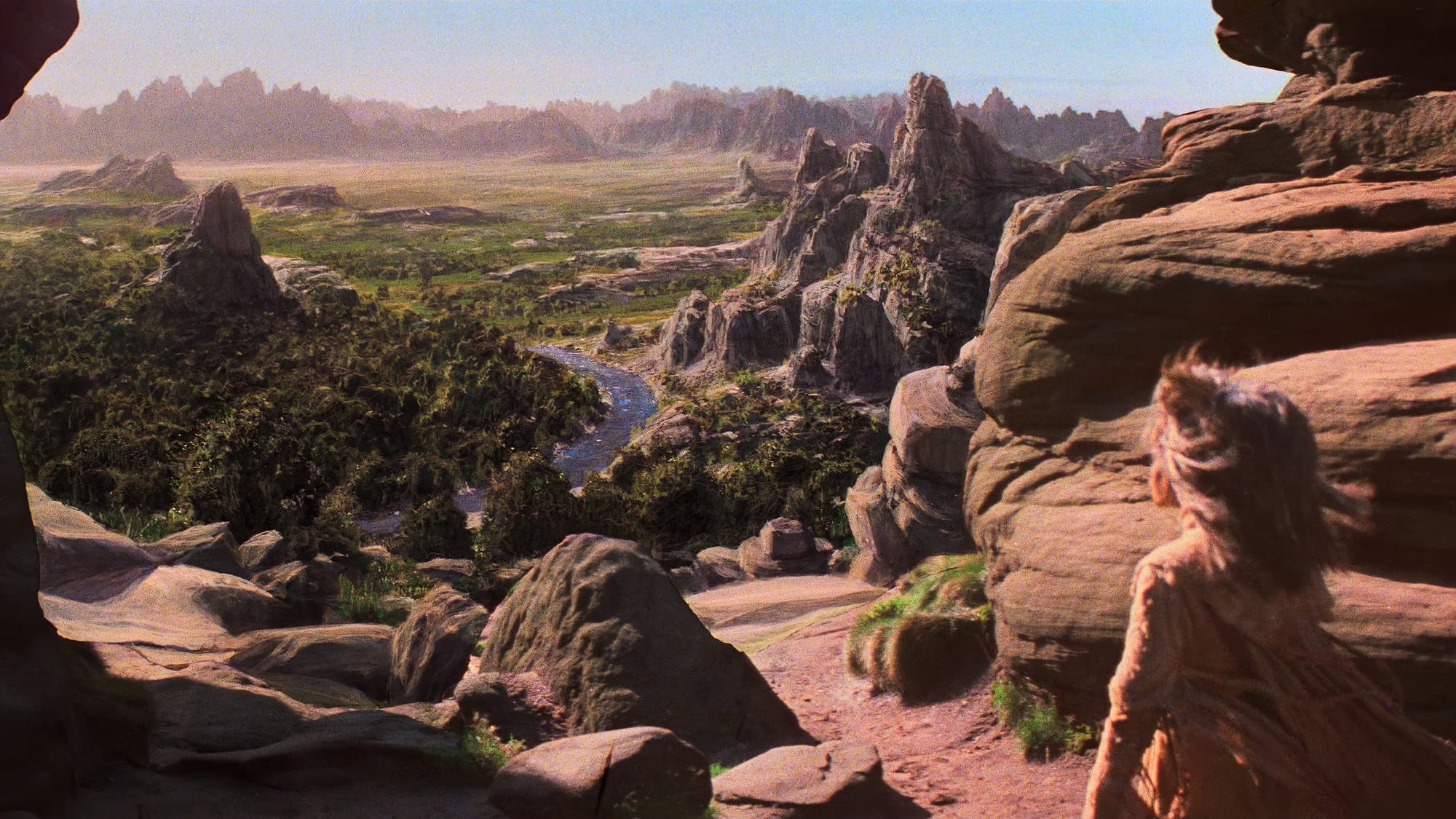
At our worst, we are all Skeksis, stumbling into fear-driven rages and hatreds that perpetuate harm to ourselves and our neighbors, carving out our own little hells — actual Hells — in this cosmos full of light.
At our best, we are the longsuffering Mystics who patiently yearn for the fulfillment of the prophecies — a new heaven and a new earth!
Or perhaps we follow the Gelfling path. The Dark Crystal reminds us that we can follow in the footsteps of the humble one — represented here by both male and female heroes who take leaps of faith and put their lives on the line for the healing of the world. Jen and Kira suffer the persecution brought upon them by the Skeksis, who do so because of the misery of their self-made hells, in order to shine an irresistible light that brings about a great salvation, that literal apocalypse for which our hearts cry out.
That’s a lot to draw out of this innovative, fascinating fantasy. But I hear that meaningful music every time I see it. As dark and violent a movie as The Dark Crystal is, it rings true and it gives me hope in hard times.